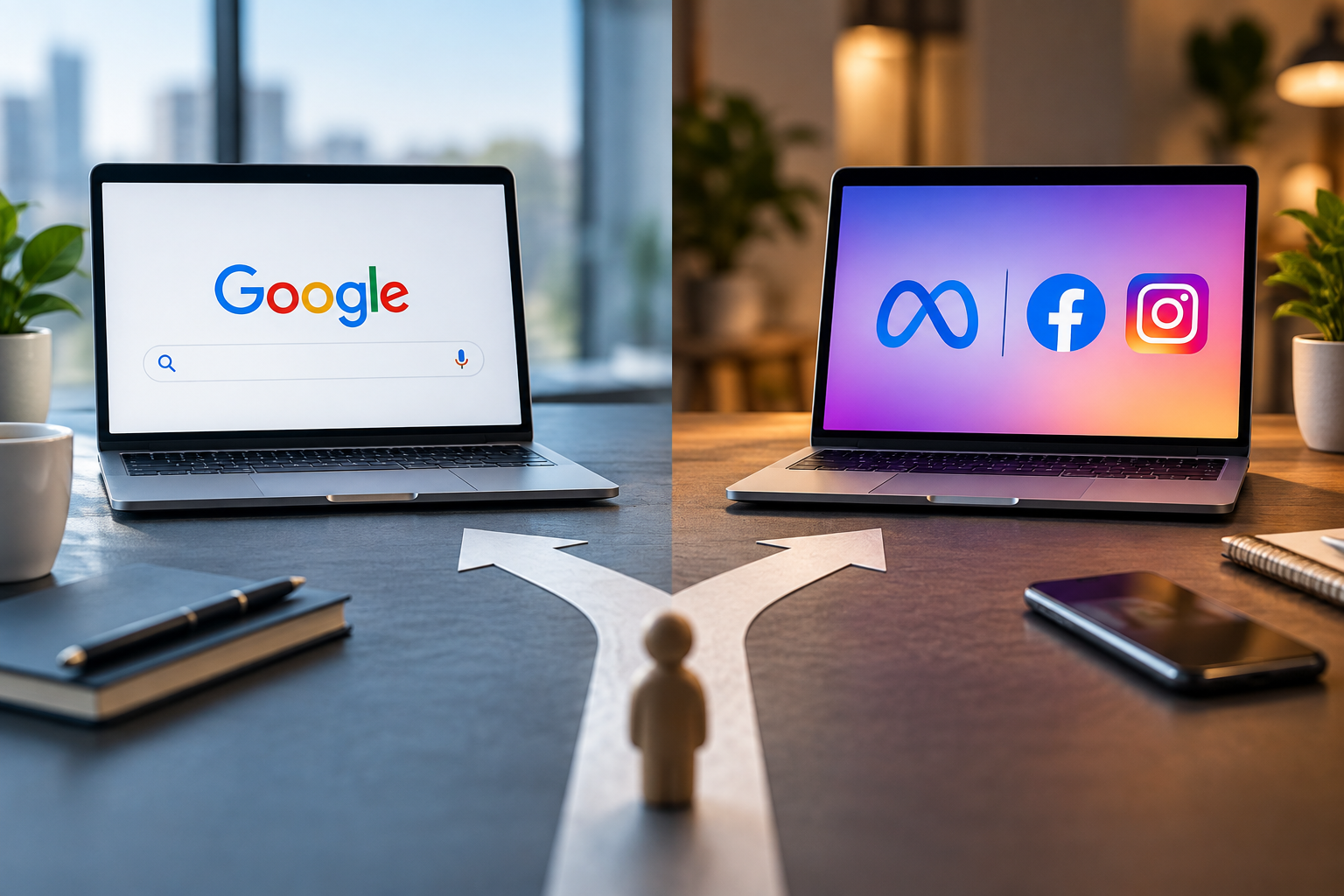
If you have a limited advertising budget, should you spend it on Google Ads or Meta Ads?
It’s a question I get asked regularly, and the answer isn’t as simple as saying one platform is better than the other.
Both can generate leads and sales.
The difference is often where your potential customer is in their buying journey when they see your ad.
With Google Search Ads, you’re generally reaching somebody who is actively searching for a product or service. Google itself describes Search campaigns as a way to reach people while they’re actively searching for what you offer.
With Meta Ads across platforms such as Facebook and Instagram, you’re often putting your business in front of somebody before they’ve actively searched for it.
A simple way to think about it is:
Google Ads captures existing demand. Meta Ads can help create demand.
But that doesn’t automatically make Google better.
The right platform depends on your business, what you sell, how customers buy, the existing search demand, your budget and — importantly — what happens after the lead comes in.
Because the platform generating the most leads isn’t necessarily generating the most business.
Google Ads vs Meta Ads: The Quick Answer
If people are already searching for the product or service you provide, Google Ads would usually be the first platform I’d investigate.
If you have a visually strong product, need to build awareness or you’re selling something people aren’t necessarily searching for yet, Meta Ads may be the better starting point.
For some businesses, using both platforms together makes complete sense.
But I wouldn’t automatically tell a small business to split its advertising budget between Google and Meta simply because using multiple channels sounds like a more sophisticated marketing strategy.
If the budget is limited, I’d rather establish:
Where are we most likely to reach the right potential customer?
Start there.
Measure what happens.
Then use the data to decide where the next part of the budget should go.
What’s the Main Difference Between Google Ads and Meta Ads?
The biggest difference is intent.
Imagine you need somebody to repair your roof.
You open Google and search:
“roof repair company near me”
You’re not casually researching roofing companies for entertainment.
You have a problem and you’re actively looking for somebody who can solve it.
That’s the environment in which Google Search Ads can be extremely powerful.
Google specifically positions Search campaigns around reaching people who are actively searching for the products and services a business offers.
Now imagine you’re scrolling through Instagram.
You see an advert for a beautiful outdoor furniture set.
You weren’t searching for garden furniture.
But the ad catches your attention.
You start thinking about the patio you’ve been meaning to sort out.
You click.
That’s a very different customer journey.
Neither is inherently better.
They’re reaching people at different moments.
And that’s one of the first things I consider when deciding which advertising platform makes sense for a business.
When Would I Choose Google Ads?
I’d usually investigate Google Ads first when there’s clear existing search demand and strong commercial intent.
This can work particularly well for businesses such as:
- trades and home services;
- professional services;
- clinics and healthcare services;
- local businesses;
- B2B services;
- businesses generating enquiries or quotations;
- e-commerce businesses selling products people actively search for.
The big advantage is timing.
Someone might search:
“accountant Dublin”
“emergency plumber Wexford”
“self storage Kildare”
“psychologist near me”
“office fit out company Ireland”
They’re telling Google what they need.
Your advertising can put your business in front of them at that moment.
Google Search campaigns can be optimised around objectives including leads and sales, and Google’s current campaign setup requires advertisers to define conversion goals used for campaign optimisation.
But that doesn’t mean simply switching on Google Ads guarantees good leads.
Your targeting, search terms, location settings, conversion tracking, ads, landing pages, budget and ongoing optimisation all matter.
When Would I Choose Meta Ads?
Meta can be extremely effective when discovery and creative play a bigger role in the buying decision.
I’d be more likely to consider Meta first for businesses where:
- the product is visually appealing;
- customers may not know the product exists;
- demand needs to be created;
- social proof is particularly powerful;
- video can demonstrate the product;
- the buying decision is driven by inspiration;
- building an audience is important;
- repeat exposure helps move someone towards purchasing.
Think fashion, interiors, beauty, food, events and certain consumer products.
Someone doesn’t necessarily wake up and Google the exact product.
They see it, want it and then investigate it.
This is why reducing the decision to:
Google = sales
Meta = awareness
is too simplistic.
Meta can absolutely generate sales and leads.
And Google can play a role beyond somebody immediately searching and buying.
The important question is how your particular customer discovers and buys what you sell.
Which Generates Better Quality Leads?
This is where things get much more interesting.
And it’s also where simply comparing cost per lead can be very misleading.
I recently had a client come to me looking for help with Google Ads after previously using Facebook Ads.
On paper, the Facebook campaigns looked good.
They were generating plenty of leads and, if we judged the campaign purely by the number of enquiries or the cost of generating each one, Meta could easily have appeared to be performing extremely well.
But when we looked at what happened after those enquiries came in, the picture was very different.
A lot of them were what the client described as “tyre kickers”.
The business was spending time:
- responding to enquiries;
- qualifying people;
- arranging appointments;
- travelling out to potential customers;
- preparing quotations;
only for many of those enquiries to go nowhere.
That time has a cost.
For this particular business, Google Ads made sense because we could target people actively searching for the service.
Those potential customers were generally further along in the buying journey. They already knew they needed the service and were looking for a company that could provide it.
That can mean fewer enquiries but better-quality enquiries.
And commercially, that’s potentially far more valuable.
This is why I don’t judge advertising performance purely by asking:
How many leads did we generate?
I want to know:
How many were qualified?
How many became customers?
How much time did they take to convert?
What did it cost the business to win that customer?
How much was that customer ultimately worth?
A €10 lead isn’t cheap if it goes nowhere.
A €40 lead can be considerably better value if it becomes a profitable customer.
“Don’t Just Measure Cost Per Lead”
This deserves its own section because it’s one of the easiest numbers to misunderstand.
Imagine:
Meta Ads
50 leads
€10 per lead
€500 advertising spend
Google Ads
20 leads
€25 per lead
€500 advertising spend
Looking only at cost per lead:
Meta wins easily.
But now imagine only two of those 50 Meta leads become customers, while eight of the 20 Google leads become customers.
Suddenly:
Meta customer acquisition cost = €250
Google customer acquisition cost = €62.50
Same advertising budget.
Completely different commercial outcome.
Those are illustrative figures, but the principle is important:
Don’t optimise for the cheapest lead. Optimise for the right customer.
And ideally, take it one step further.
Look at the revenue and profit those customers ultimately generate.
That’s when you’re starting to measure actual advertising ROI, rather than whichever metric makes the dashboard look best.
Google Ads vs Meta Ads: Which Is Cheaper?
This is one of the most common questions — and one of the least useful without context.
Meta may generate cheaper clicks or leads in many situations.
Google clicks can become expensive in competitive industries.
But:
Cheaper doesn’t automatically mean better value.
I’d rather pay €5 for a click from someone genuinely looking for what you sell than €1 for five people who have very little intention of buying.
The same applies to leads.
This is why comparing average CPC figures from different industries or articles isn’t particularly helpful when deciding what your business should do.
What matters is what happens in your campaign:
Cost per click → conversion rate → cost per qualified lead → customer acquisition cost → revenue/profit.
That’s the chain I’d rather measure.
Which Is Better for Local Service Businesses?
For many local service businesses, Google Search Ads would be my first port of call.
Why?
Intent.
If somebody needs a plumber, storage company, security company, physiotherapist or accountant, there’s a good chance they’ll actively search for one.
That gives us an opportunity to reach them when the need already exists.
I’ve managed Google Ads for local businesses where that combination of location + service + intent is precisely what makes paid search valuable.
But there are exceptions.
If you’re launching a new type of service that people don’t know exists, Google can’t capture search demand that isn’t there.
That’s when another platform may be better at introducing the idea in the first place.
Google’s own Ads Insights tools now include search-demand information that can help advertisers understand interest in products and services and identify changes in demand.
That’s another reason I like to look at the data before recommending the channel.
Which Is Better for E-commerce?
This one is much less clear-cut.
For e-commerce, Google and Meta can both be excellent.
Google can capture shoppers actively searching for products.
Meta can introduce products to customers through visual creative and build demand before somebody ever searches.
And the customer journey might involve both.
Someone could:
see the product on Instagram → visit the website → leave → search for the brand on Google three days later → purchase.
Which platform generated the sale?
That’s where attribution gets messy.
I’ve worked with e-commerce businesses where looking only at the final click wouldn’t tell the whole story.
I’d look at:
- the product;
- margin;
- average order value;
- customer lifetime value;
- search demand;
- creative;
- conversion rate;
- remarketing opportunities;
- overall customer journey.
Then decide where the budget is most likely to work hardest.
Which Is Better for B2B?
For B2B services with clear existing search demand, Google Ads can be extremely useful.
Someone searching for a specialist supplier, consultant, software solution or commercial service may already be actively evaluating providers.
But B2B sales cycles can also be long.
One Google click might not immediately produce a sale.
A potential client might:
search → visit → research → leave → return → speak to colleagues → compare suppliers → enquire weeks later.
So I’d be particularly careful about judging B2B campaigns solely on immediate conversions.
The quality and commercial value of the opportunity matters.
Five strong enquiries for a high-value B2B service could be worth considerably more than 100 low-value leads elsewhere.
What Budget Do You Need for Google Ads vs Meta Ads?
There’s no useful universal answer such as:
“Every small business should start with €500.”
The appropriate budget depends on things such as:
- what clicks cost in your market;
- how many potential customers are searching;
- your geographic area;
- competition;
- conversion rate;
- average customer value;
- margins;
- campaign objectives.
A €1,000 monthly budget might be perfectly workable for one local campaign and nowhere near enough for another highly competitive market.
This is also why I wouldn’t automatically split a limited budget between Google and Meta.
Imagine you have €1,000.
Putting €500 into Google and €500 into Meta may sound sensible because you’re “testing both”.
But it could also mean neither campaign receives enough budget or data to tell us very much at all.
Sometimes I’d rather concentrate the budget where the strongest opportunity appears to be, learn from the results and expand from there.
When Should You Use Google Ads and Meta Ads Together?
There are situations where Google Ads and Meta Ads can work very well together because they reach potential customers at different stages of the buying journey.
For example:
Meta creates awareness → customer searches Google later → Google captures that existing demand.
Or:
Customer discovers your business through Google → visits your website → sees your Meta advertising later → returns and converts.
This is often a more realistic picture of how people buy. A customer may interact with your business several times, across different channels, before they’re ready to enquire or make a purchase.
But using both platforms isn’t automatically the best strategy for every small business.
Before splitting your advertising budget across Google and Meta, I’d consider whether you have enough:
- budget;
- existing demand;
- strong creative;
- reliable conversion tracking;
- data to make informed decisions;
- capacity to manage and follow up on the leads generated.
If the budget is limited, I’d often rather get one channel working properly first, measure the quality of the leads or sales it generates and then use that data to decide whether expanding into another channel makes commercial sense.
More channels don’t automatically mean better marketing.
The goal is to put your budget where it’s most likely to generate the right customers and the best return for your business.
Your Landing Page Matters More Than You Think
Sometimes businesses blame the advertising platform when the real problem is what happens after somebody clicks.
Imagine you’ve paid to bring someone to your website.
They arrive and:
- can’t immediately understand what you offer;
- can’t find the information they need;
- don’t trust the business;
- encounter a terrible mobile experience;
- have to fill out a 17-field form;
- can’t see a clear next step.
That’s not necessarily a Google Ads or Meta Ads problem.
It’s a website conversion problem.
I’ve worked on campaigns where improving the customer journey was just as important as optimising the advertising itself.
Paid advertising can bring the right person to the door.
Your website still has to convince them to come in
Conversion Tracking Needs to Be Right Too
Before judging either platform, make sure you’re measuring the actions that actually matter.
For a service business, that might include:
- enquiry forms;
- phone calls;
- bookings;
- quote requests.
For e-commerce:
- purchases;
- revenue;
- product performance;
- customer acquisition.
Google’s current Search campaign setup requires conversion goals, and its reporting provides conversion and conversion-value information to help advertisers understand which searches are driving performance.
But again, a tracked lead isn’t necessarily a good lead.
That’s why I like feedback from the business itself.
Analytics tells me somebody enquired.
The client tells me:
“That became a €5,000 customer.”
Those are very different pieces of information — and I want both.
When I Wouldn’t Recommend Google Ads
I manage Google Ads.
But that doesn’t mean I think every business should be running them.
There are situations where I wouldn’t recommend putting money into Google Ads.
For example:
- there isn’t enough relevant search demand;
- the economics don’t stack up;
- the website isn’t ready to convert;
- the business can’t handle additional enquiries;
- another marketing channel is better suited to how customers discover the product;
- the available budget isn’t realistic for the market.
I’ve turned businesses away or recommended a different approach when I didn’t believe SEO or Google Ads was the right investment at that particular point.
I’d rather tell somebody:
“I don’t think this is where you should put your money.”
than take the budget and spend the next six months trying to prove myself wrong.
The channel should fit the business.
Not the service I happen to sell.
So, Google Ads or Meta Ads?
If you’re deciding between them, start with these questions:
- Are people already searching for what you sell?
- How much existing search demand is there?
- Is your product or service something people discover rather than search for?
- How visual is the buying decision?
- How quickly does somebody normally decide to buy?
- What’s a customer actually worth to you?
- How much can you realistically spend?
- Can you properly track enquiries and sales?
- How good is your website at converting visitors?
- What happens to leads after they arrive?
Then measure the result.
Not just clicks.
Not just impressions.
Not even just leads.
Measure what turns into business.
That’s how you work out which advertising platform is actually delivering the better return.
Frequently Asked Questions
Is Google Ads better than Meta Ads?
Neither platform is universally better.
Google Ads can be particularly effective when people are already searching for your product or service, while Meta can be powerful for discovery, awareness and visually driven products.
The right choice depends on your customer, buying journey, search demand, budget and commercial goals.
Are Google Ads more expensive than Facebook Ads?
They can be, particularly in competitive search markets.
However, comparing cost per click alone doesn’t tell you which platform is more profitable.
A more expensive click can still deliver better ROI if that visitor has stronger buying intent and is more likely to become a customer.
Which is better for generating leads?
Both platforms can generate leads.
The more useful question is:
Which generates better-quality leads for your business?
Measure qualified leads, conversion to customer, acquisition cost and eventual revenue rather than only total lead volume.
Should a small business use Google Ads or Facebook Ads?
If people are already searching for the service you provide, I’d normally investigate Google Search Ads first.
If the business needs to generate awareness or has a highly visual product that benefits from discovery, Facebook and Instagram advertising may be more appropriate.
Budget matters too. Don’t automatically spread a limited advertising budget across multiple platforms.
Can I use Google Ads and Meta Ads together?
Yes.
They can work particularly well at different stages of the customer journey.
However, using both isn’t automatically better. Make sure you have enough budget, tracking and creative resources to run both properly.
Can I run Google Ads myself?
Yes.
Google Ads doesn’t require an agency to operate it.
But there is a difference between running ads and running profitable ads.
Campaign structure, keyword targeting, search terms, bidding, conversion tracking, landing pages and ongoing optimisation all influence performance.
If you’re managing campaigns yourself, I’d pay particular attention to what you’re actually counting as a conversion and whether those conversions are turning into customers.
Which Advertising Platform Is Right for Your Business?
Google Ads and Meta Ads can both produce excellent results.
But I wouldn’t choose between them based on which has the cheapest clicks, the most fashionable targeting or the biggest number of leads.
I’d look at:
Where are your customers?
What are they doing when they encounter your business?
How ready are they to buy?
What happens after they enquire?
And ultimately — which channel produces profitable customers?
That’s the difference between running ads and using paid advertising strategically.
At New Era Digital, our Google Ads Management focuses on reaching the right potential customers, measuring what happens and continually improving performance based on real campaign data.
Explore Google Ads Management →
Not sure whether Google Ads is actually the right channel for your business?
Book a free 15-minute consultation
I’ll tell you if I think it isn’t.