The customer journey used to be relatively easy to understand.
Someone needed a product or service, searched Google, clicked through to a website, compared their options and eventually made an enquiry or purchase.
It was never quite as linear as the traditional marketing funnel suggested, but businesses could usually see a reasonable amount of that journey through search rankings, website traffic and analytics.
AI has changed that.
Today, a potential customer might ask ChatGPT for recommendations, use Google’s AI Mode to research a problem, encounter an AI Overview in Google Search, compare several products or businesses with AI, check reviews and only visit a company’s website once they’ve already narrowed down their options.
And this isn’t a small fringe change in search behaviour. Google says AI Mode has surpassed one billion monthly active users globally and that people are asking different, more conversational questions.
Whether you’re a business owner, marketing manager or responsible for growing a business online, understanding this new AI customer journey is becoming increasingly important.
AI hasn’t simply introduced another marketing channel. It’s changing where customers discover businesses, how they research their options, what influences their decisions and what happens before they ever reach your website.
What Is the AI Customer Journey?
The AI customer journey describes the way artificial intelligence influences the different stages someone goes through before, during and after becoming a customer.
That can happen in two ways.
First, customers are using AI themselves.
They can use tools such as ChatGPT, Google AI Mode and Gemini to research products, understand complicated subjects, discover businesses, compare alternatives and ask follow-up questions.
Second, businesses are using AI within the customer experience.
That includes personalised recommendations, intelligent search, chatbots, customer support, predictive analytics and AI assistants.
So AI isn’t simply another marketing channel.
It’s becoming part of the journey itself.
The Customer Journey Before and After AI
One of the easiest ways to understand the change is to compare the traditional customer journey with what can happen today.
| Traditional Customer Journey | AI-Influenced Customer Journey |
|---|---|
| Customer recognises a need | Customer recognises a need |
| Searches Google | Searches Google or asks an AI platform |
| Browses search results | Receives answers, summaries and recommendations |
| Visits several websites | May research businesses before visiting them |
| Compares products or services | AI can help research and compare options |
| Reads reviews | Reviews and third-party information can inform the research |
| Returns to chosen website | Searches for or visits a shortlisted brand |
| Enquires or purchases | Enquires or purchases |
| Receives traditional support | May interact with AI-assisted support |
The important difference is that your website may enter the customer journey considerably later than it once did.
That’s a significant change for businesses.
It affects SEO and digital marketing, but also how you think about your website, customer experience, brand reputation and the information potential customers can find about you online.
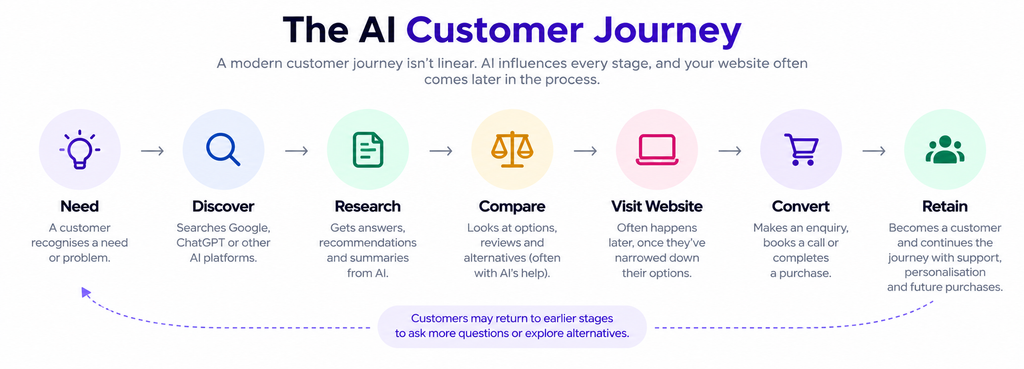
AI Customer Journey Infographic 2026
Our updated AI customer journey infographic shows how customers can move from discovery and AI-assisted research through to comparison, conversion and retention.
1. AI Is Changing How Customers Discover Businesses
Discovery used to be heavily influenced by traditional search engines.
If you wanted a plumber, accountant, pair of running shoes or SEO agency, you probably searched Google and worked your way through the results.
That’s still happening, but the search itself is changing.
Customers can now ask questions such as:
“Which SEO agencies in Ireland specialise in small businesses?”
“What’s the best running shoe for a beginner with wide feet?”
“Recommend an accountant near Wexford for a small limited company.”
Instead of receiving only a list of links, they may receive a generated response that helps them understand the subject or narrow down their options.
Google itself says people are increasingly gravitating towards generative AI experiences to find information, while its AI search features remain rooted in Google’s core Search ranking and quality systems.
Google’s guide to optimising for generative AI features
What does that mean for a business owner?
The practical question is no longer simply:
“Does my website rank on Google?”
You also need to consider whether your business is visible when potential customers use AI-powered search experiences to research the products, services or expertise you provide.
Someone might discover your brand through an AI-generated answer and only search for your business directly afterwards.
That changes what we mean by search visibility.
2. Research Can Happen Before Someone Visits Your Website
This is one of the biggest changes I’ve seen in the search journey.
Traditionally, websites did much of the research work.
A potential customer landed on your site, read your service pages, visited your About page, looked at testimonials and compared you with competitors.
AI can now do part of that research with them.
Someone can ask:
“Compare these three companies.”
“What are the pros and cons of this product?”
“What should I look for when choosing an SEO agency?”
“How much should SEO cost in Ireland?”
They can then ask follow-up questions and refine what they’re looking for without starting another traditional search.
Google’s own research into AI Mode says people are asking longer and more complex questions, while its AI Mode experience is explicitly designed to support follow-up exploration.
The customer can therefore arrive at a website already knowing what they want, what questions to ask and which businesses they’re considering.
The website still matters enormously.
But it isn’t necessarily where the research begins.
3. AI Is Making the Customer Journey Less Linear
We’ve talked about marketing funnels for decades:
Awareness → consideration → decision → purchase.
Real customer behaviour has always been messier than that.
AI makes it messier still.
A customer might:
See a business on Google → ask ChatGPT about the category → check reviews → return to Google → visit the website → use AI to research alternatives → return directly → convert.
Another customer might begin entirely inside an AI platform.
There isn’t necessarily one channel responsible for that customer.
And that’s where measurement gets interesting.
4. Can You Track the AI Customer Journey in GA4?
Partly.
This is an area where the situation has moved on considerably.
If someone clicks a link to your website from an AI platform and referral information is passed, GA4 can identify the source that originated the session through its traffic-source reporting. Google defines Source as the website, platform or other location that referred the user.
So direct click-through traffic from AI platforms isn’t necessarily invisible.
You can use GA4 to investigate identifiable AI referral traffic and then look at what those visitors do on your website.
But there’s still a significant part of the journey analytics can’t see.
Imagine someone:
Discovers your business in ChatGPT → researches you there → closes ChatGPT → searches your company name on Google → visits your website.
GA4 can see the website session and its attributable source.
It can’t reconstruct the earlier ChatGPT conversation that influenced the person’s decision to search for your brand.
That’s why AI referral traffic shouldn’t be treated as a complete measure of AI visibility.
And Search Console has changed too
As of September 2026, Google Search Console provides dedicated Search Generative AI performance reports.
These reports give website owners visibility into impressions within Google’s generative AI search features, including AI Overviews and AI Mode. Google completed the worldwide rollout on 31 August 2026.
That’s an important development because businesses now have more first-party data for understanding visibility within Google’s AI-powered search experiences.
Read Google’s announcement about generative AI reporting in Search Console
For AI customer journey measurement, I would therefore look at several signals together:
- AI referral traffic in GA4
- Google AI visibility in Search Console
- branded search demand
- direct traffic
- leads and sales
- AI citations and brand mentions
- recommendation visibility across relevant AI platforms
No single metric tells you the entire story.
5. AI Is Changing How Customers Compare Their Options
Comparison is another area where AI can shorten the research process.
Instead of opening six browser tabs and manually comparing different businesses, someone can ask an AI assistant to help organise the information.
For example:
“Compare these three SEO agencies based on their services, experience and suitability for a small Irish business.”
Or:
“Compare these four laptops and tell me which is best for graphic design.”
The customer can then investigate a shortlist rather than starting from scratch.
This changes what businesses need to communicate online.
Your website should clearly answer:
What do you do?
Who do you help?
Where do you operate?
What makes you different?
What evidence supports your claims?
What does your product or service include?
Clear, accurate information helps potential customers understand your business — regardless of whether they encounter that information directly on your website or through search.
6. AI Is Changing the Relationship Between Visibility and Website Traffic
This is another area businesses need to understand.
Historically, SEO visibility and website traffic were closely connected: rank higher, earn the click, get the visitor.
AI-generated search experiences can sometimes answer part or all of the user’s question before they visit another website.
There is evidence of this behaviour.
A Pew Research Center analysis of Google searches found users clicked a traditional search result in 8% of visits where an AI summary appeared, compared with 15% when one did not. Clicking a source directly within an AI summary occurred in just 1% of visits in the study.
Read the Pew Research Center study on AI summaries and search clicks
That study looked at US browsing behaviour in 2025, so I wouldn’t apply those percentages universally to every market or query.
But it demonstrates an important point:
Visibility doesn’t always result in an immediate website visit.
For businesses, that means declining or changing click patterns shouldn’t automatically be interpreted without considering what’s happening across the wider search journey.
7. Trust and Reputation Matter Earlier in the Journey
AI hasn’t removed the need for trust.
If anything, I think it makes trust more important.
If an AI-generated answer introduces someone to a company they’ve never encountered before, they’re likely to want to validate that business before buying.
That might mean looking at:
- reviews
- case studies
- the people behind the company
- independent mentions
- social profiles
- industry memberships
- authoritative third-party websites
This is why businesses shouldn’t think about AI search as purely an on-page SEO exercise.
Your website is one part of your digital footprint.
Your wider reputation matters too.
8. Customers Can Arrive at Your Website Further Down the Funnel
This has an interesting implication for conversion rate optimisation.
If someone has already spent time researching your business using AI, their website visit may look very different from someone discovering you for the first time.
They might not read six blog articles.
They might land directly on a service page, look for pricing, check your reviews and enquire.
That’s why less browsing doesn’t automatically mean less interest.
Businesses need websites that work for customers arriving at different stages of the journey.
Someone discovering you needs education.
Someone who has already researched you needs reassurance and an easy route to conversion.
Your website needs to handle both.
9. AI Is Increasing Expectations Around Personalisation and Speed
AI is also changing what customers expect once they interact with businesses.
People are becoming accustomed to:
- personalised recommendations
- instant answers
- intelligent search
- conversational interfaces
- faster support
That doesn’t mean every small business needs an AI chatbot attached to its homepage.
I’d much rather see a business provide an excellent, straightforward customer experience than introduce AI simply because everyone is talking about it.
The useful question is:
Where can AI genuinely remove friction from this customer’s journey?
Sometimes that’s personalisation.
Sometimes it’s better website search.
Sometimes it’s faster customer service.
And sometimes the correct answer is nowhere yet.
10. AI Is Changing Customer Service and Retention
The AI customer journey doesn’t end when someone purchases.
Businesses are increasingly using AI to assist with customer support, frequently asked questions, product recommendations, onboarding, customer feedback and identifying recurring problems.
Used well, this can improve speed and convenience.
But there are also situations where customers simply want to deal with another person.
The goal shouldn’t be maximum automation.
It should be a better customer experience.
AI Hasn’t Just Changed the Journey — It’s Changed Customer Expectations
This is perhaps the bigger shift.
Customers increasingly expect information to be:
Fast. They don’t want to hunt through five pages to find a straightforward answer.
Relevant. Generic information is less useful when more personalised answers are available.
Easy to understand. Complicated information can increasingly be summarised and explored conversationally.
Consistent. Contradictory information across websites, listings and platforms creates friction.
Trustworthy. People still need confidence before handing over money.
Businesses aren’t simply competing for a blue link anymore.
They’re competing to be discovered, understood and trusted throughout a much broader digital journey.
How AI Changes the Customer Journey for Different Businesses
The impact isn’t identical for every business.
Local businesses
A potential customer might ask:
“Who is the best-rated physiotherapist near me?”
AI-assisted discovery could influence which businesses they investigate.
Local SEO, reviews, Google Business Profile optimisation, accurate business information and third-party reputation therefore remain important.
Ecommerce businesses
Product discovery is particularly interesting.
Customers can use AI to research questions such as:
“What’s the best moisturiser for sensitive skin under €40?”
or:
“Which running shoes are best for beginners?”
That makes detailed product information, specifications, genuine reviews, comparison content and brand authority increasingly valuable.
B2B businesses
B2B buyers often have longer research journeys.
AI can help them understand unfamiliar services, research potential suppliers and compare vendors before speaking to sales.
Your website therefore needs to communicate expertise and differentiation, not merely describe what you sell.
Professional services
Trust plays an enormous role here.
Someone looking for an accountant, solicitor, consultant or SEO specialist may use AI to research potential providers before validating their experience, reputation and expertise elsewhere.
This is where personal authority and business authority increasingly overlap.
What Does the AI Customer Journey Mean for Your Marketing?
For businesses, one of the biggest implications is that SEO can no longer be viewed purely as rankings and website traffic.
Your potential customers may encounter your brand across traditional Google results, Google Maps, AI Overviews, AI Mode, ChatGPT, Gemini, Perplexity, review platforms, social media and third-party websites before they ever contact you.
SEO isn’t disappearing.
It’s expanding.
In May 2026, Google published dedicated guidance for generative AI search and explicitly stated that established SEO best practices remain relevant because its generative AI features are rooted in Google’s existing Search ranking and quality systems.
So businesses still need strong traditional SEO.
But we also need to think about whether a business can be understood, surfaced, cited and recommended within AI-powered search experiences.
That’s where newer areas such as Answer Engine Optimisation (AEO) and Generative Engine Optimisation (GEO) come into the picture.
If these terms are new to you, I’ve explained what Answer Engine Optimisation is and what Generative Engine Optimisation is in more detail in our guides.
If you’re particularly interested in AI recommendations, you can also read how to get AI to recommend your business.
And for ChatGPT specifically, see how to get your website to show up in ChatGPT.
The goal isn’t to replace SEO with a collection of shiny new acronyms.
It’s to make your business visible wherever customers are searching and researching.
What Should Business Owners and Marketing Managers Do Now?
You don’t need to rebuild your entire marketing strategy around AI.
What you do need is a clearer understanding of how your customers discover, research, compare and choose businesses today, and whether your existing marketing reflects that journey.
I’d start with seven areas.
1. Map your current customer journey
Identify how people discover, research, compare and choose your business.
Don’t assume Google or your website is always the first interaction.
2. Measure more than website traffic
Use GA4 to investigate identifiable AI referral traffic and Search Console’s generative AI reporting to understand your visibility within Google’s AI search experiences.
Then look at those metrics alongside branded search, leads, sales and direct traffic.
3. Answer real customer questions
Create genuinely useful content around the questions people ask before buying.
Those are increasingly the types of detailed questions people can ask both search engines and AI platforms.
4. Strengthen your brand authority
Reviews, case studies, genuine expert content and credible third-party mentions help customers establish whether they can trust your business.
5. Make your business easy to understand
Clearly communicate who you are, what you do, who you help, where you operate and why someone should choose you.
6. Improve the website experience
Customers arriving after AI-assisted research may already be close to making a decision.
Don’t make them hunt for the information they need.
7. Monitor your visibility across search and AI
Look beyond one platform.
For New Era Digital, for example, we monitor visibility across traditional Google Search alongside Google’s AI experiences and platforms such as ChatGPT, Gemini and Perplexity.
This isn’t about chasing every new AI development.
It’s about adapting your marketing strategy to how people are actually searching, researching and buying now.
Frequently Asked Questions About AI and the Customer Journey
How has AI changed the customer journey?
AI has changed the customer journey by influencing how people discover, research, compare and choose businesses. Customers can now use AI-generated answers and conversational search during the buying process, while businesses are also using AI for personalisation, support and customer analysis.
What is an AI customer journey?
An AI customer journey is a customer journey where artificial intelligence influences one or more stages, including discovery, research, evaluation, purchase, customer service or retention.
Can you track traffic from ChatGPT in GA4?
Yes, when a visitor clicks through to your website and identifiable referral information is available, GA4’s traffic-source reporting can show where that session originated. However, GA4 cannot show you AI interactions that happened away from your website and didn’t result in a directly attributable click.
Can you see AI visibility in Google Search Console?
Yes. As of September 2026, Google Search Console has dedicated generative AI performance reporting showing visibility within Google’s AI search features, including AI Overviews and AI Mode. Google says the reports were rolled out worldwide by 31 August 2026.
Is AI reducing clicks from Google?
It can affect click behaviour for some searches. A 2025 Pew Research Center study found substantially lower traditional-result click rates when an AI summary appeared, although the study was based on US browsing data and shouldn’t be treated as a universal click-through rate for every search.
Is AI replacing traditional search?
No. Traditional search remains important, but search itself is increasingly incorporating generative AI. Google’s own 2026 guidance says traditional SEO best practices continue to apply to its generative AI search features.
Does my business need to optimise for AI search?
If customers use search and online research to choose businesses in your market, AI visibility is increasingly worth considering alongside traditional SEO.
The fundamentals remain familiar: useful content, clear information, technical accessibility, authority and a trustworthy online presence.
The Customer Journey Has Changed. Your Marketing Needs to See the Whole Picture.
After more than 15 years working in SEO and digital marketing, I’ve watched the customer journey change repeatedly.
Mobile changed it.
Social media changed it.
Google Maps changed it.
Online reviews changed it.
AI is changing it again.
But the fundamental principles haven’t disappeared.
Be useful. Be visible. Be trustworthy. Make it easy for customers to understand why they should choose you.
What’s changing is where those customers discover you, how they research you and how much they may already know about your business before they ever reach your website.
For business owners and marketing managers, that’s the real shift to pay attention to.
Modern SEO isn’t simply about asking:
“Where do we rank on Google?”
We also need to ask:
“Where does our business appear throughout the customer’s search and research journey?”
That’s why our approach to AI SEO & GEO services combines established SEO with optimisation for the way customers now search across Google and AI-powered platforms.