Search is changing.
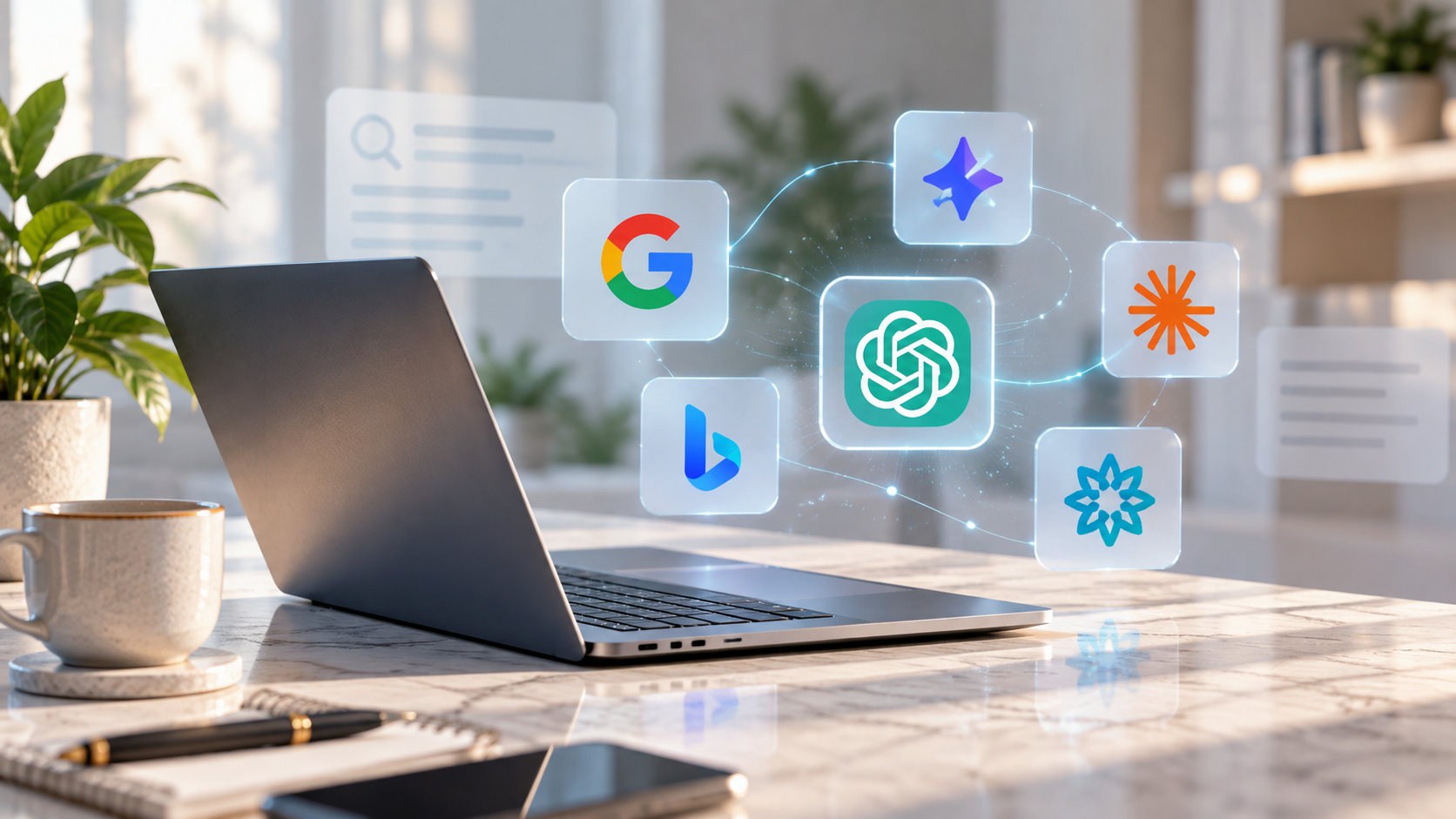
People are no longer relying solely on traditional Google search results to find businesses, products and information. They are also asking questions through Google AI Overviews and AI Mode, ChatGPT, Perplexity and Gemini.
That has created a new area of search optimisation known as Generative Engine Optimisation (GEO).
GEO focuses on making your business and content easier for AI-powered search engines to understand, trust, reference and potentially recommend in generated answers.
It doesn’t replace SEO. In practice, good GEO builds on strong SEO foundations while adapting your content and wider online presence for the way AI search works.
What Is Generative Engine Optimisation (GEO)?
Generative Engine Optimisation (GEO) is the process of improving your website, content and online authority so that AI-powered search engines can understand your information and potentially use, cite or recommend it when generating answers.
Traditional search engines usually return a list of webpages.
Generative search engines can instead combine information from several sources to create an answer directly for the user.
For example, someone might ask:
“What are the best SEO agencies in Ireland for a small business?”
Instead of simply showing ten blue links, an AI search engine may generate an answer containing several recommended businesses, explanations and source citations.
GEO is about improving the chances that your business becomes one of the sources or brands considered in that answer.
The term itself emerged from academic research into optimising visibility within generative engines. The original GEO research introduced the concept as a framework for helping content creators improve their visibility within generative responses.
Read the original Generative Engine Optimisation research
How Does GEO Work?
Generative engines don’t operate exactly like traditional Google search results.
Depending on the platform and query, an AI system may search or retrieve information from multiple sources before generating its response.
That means visibility isn’t necessarily just about being position one on Google.
Your content also needs to be:
- relevant to the question
- easy to understand and extract
- factually clear
- well structured
- supported by evidence where appropriate
- associated with a credible business or author
- consistent with information found elsewhere online
Recent research also suggests we shouldn’t think of GEO as one simple “AI ranking algorithm”. Visibility can involve several stages, including whether content is discovered, retrieved, cited and actually used to form the generated answer.
That’s an important distinction.
Ranking, being cited and influencing an AI-generated answer aren’t necessarily the same thing.
GEO vs SEO: What’s the Difference?
SEO and GEO have different immediate goals, but there is considerable overlap.
| SEO | GEO |
|---|---|
| Targets traditional search results | Targets generative and AI search experiences |
| Focuses heavily on rankings and organic traffic | Focuses on AI visibility, citations and brand mentions |
| Uses keywords and search queries | Also considers conversational questions and prompts |
| Builds website authority | Builds website and brand/entity authority |
| Optimises pages for crawling and indexing | Makes information easy for AI systems to retrieve and understand |
| Measures rankings, clicks and conversions | Can also measure AI mentions, citations and recommendation visibility |
The mistake would be treating these as completely separate disciplines.
Google’s own guidance now addresses terms such as GEO and AEO and says that its established SEO best practices remain relevant for appearing within Google’s generative AI search features. Google also says there are no special AI files or additional technical requirements needed to appear in these experiences.
Read Google’s guidance on optimising for generative AI search
In other words:
SEO helps search engines discover, understand and trust your website. GEO extends that thinking into AI-generated search experiences.
Is GEO replacing SEO?
No.
If anything, GEO makes many traditional SEO fundamentals more important rather than less important.
AI systems still need reliable information to work with.
A technically poor website, weak content, unclear business information and little external authority aren’t suddenly solved because someone calls their strategy GEO.
The strongest approach is therefore not:
SEO or GEO
It’s:
SEO + GEO.
Why Is GEO Important in 2026?
The way people search is becoming more fragmented.
A potential customer might discover your business through traditional Google results, Google Maps, an AI Overview, ChatGPT, Gemini, Perplexity or another AI-powered search experience.
And sometimes they may receive enough information from the generated answer that they don’t immediately visit a website.
That changes what search visibility means.
Historically, we might have concentrated heavily on:
Ranking → click → website → conversion
AI search introduces another potential journey:
Question → AI answer → brand discovery/recommendation → later search or conversion
Your brand can therefore gain visibility even when the initial interaction doesn’t produce a traditional organic click.
That’s why businesses increasingly need to consider brand visibility alongside rankings and traffic.
How Do You Optimise for GEO?
There isn’t one GEO trick that suddenly makes ChatGPT recommend your company.
And I’d be very wary of anyone promising one.
GEO is better approached as a combination of content quality, technical SEO, authority and brand signals.
1. Answer real questions clearly
AI search is heavily conversational.
People don’t always search:
SEO agency Ireland
They might ask:
“Which SEO agency in Ireland specialises in small businesses?”
or:
“How much should I pay for SEO in Ireland?”
Create content around the actual questions your potential customers ask, and answer the main question clearly near the beginning.
This is one reason question-led content is becoming increasingly valuable.
2. Make your content easy to understand
Don’t bury the answer underneath 700 words of introduction.
Use clear:
- headings
- definitions
- short explanatory sections
- lists where appropriate
- comparison tables
- FAQs
- examples
- statistics and evidence
This isn’t about writing content “for robots”.
It generally makes the content considerably better for humans too.
3. Demonstrate real expertise
AI has made it extremely easy to produce generic informational content.
That makes original experience and expertise more valuable.
Include things such as:
real client experience, original observations, case studies, first-hand examples, data, opinions based on experience and insights that aren’t simply rewrites of pages already ranking.
Google’s 2026 guidance for generative AI search specifically highlights the value of providing non-commodity content rather than simply reproducing information already available elsewhere.
For a business, this is where genuine experience can become a competitive advantage.
4. Support important claims with credible sources
When you’re making factual claims, particularly around research, statistics or rapidly changing topics, reference the original source where possible.
That’s exactly what I’m doing in this article.
Rather than simply saying “research shows GEO can improve visibility”, I can point you towards the research behind the claim.
Clear sourcing helps readers verify information and strengthens the overall quality of the content.
5. Build topical authority
One isolated article about GEO is unlikely to establish your business as an authority on AI search.
A stronger strategy is to create a connected group of useful resources around the subject.
For example:
- How to Get AI to Recommend Your Business
- What Is AEO?
- What Is GEO?
- AEO vs GEO
- How to Rank in ChatGPT
- How to Optimise for Google AI Overviews
- How to Measure AI Search Visibility
Those articles can internally link to one another and to the relevant service page.
That’s exactly how we’re structuring the AI search content here at New Era Digital.
Internal link: How to Get AI to Recommend Your Business: AEO in 2026
Internal link: AI SEO & GEO Services
6. Strengthen your authority beyond your website
GEO isn’t purely an on-page content exercise.
AI systems can encounter information about a business across the wider web.
That makes consistent third-party references increasingly interesting.
Depending on the business, these might include:
industry websites, professional associations, reputable directories, news coverage, podcasts, reviews, expert contributions and other authoritative websites.
The aim isn’t to manufacture hundreds of mentions.
It’s to build a genuine online footprint that helps establish who you are, what you do and what you’re known for.
7. Keep traditional SEO strong
Don’t abandon keyword research, technical SEO or backlinks because GEO is the shiny new thing.
You still need:
- crawlable and indexable pages
- sensible site architecture
- internal linking
- useful content
- relevant keywords
- strong titles and headings
- authoritative backlinks
- structured data where appropriate
- good user experience
Google has explicitly said that established SEO best practices remain relevant to its generative AI search experiences.
That makes traditional SEO the foundation, not the thing GEO replaces.
8. Build recognisable entities and authors
Who created the information matters.
Make it easy to understand the relationship between:
the business → the people behind it → their expertise → the subjects they specialise in.
For example, New Era Digital shouldn’t simply publish anonymous articles about SEO and AI search.
My author information should make it clear that I’m Sarah Jane Vincent, an SEO specialist with more than 15 years of hands-on experience.
That creates a much stronger connection between the content and the person responsible for it.
Can GEO Guarantee That ChatGPT Will Recommend My Business?
No.
There is no legitimate way to guarantee that ChatGPT, Gemini, Perplexity or another generative system will recommend a particular business.
Generative results can vary depending on the platform, prompt, available sources and how the system retrieves and interprets information.
Current research also cautions against oversimplifying GEO. While particular content changes can influence citation within controlled environments, researchers have not established a universal technique that guarantees lasting organic visibility across AI platforms.
That’s why I prefer to talk about improving AI search visibility, rather than promising AI rankings.
What Is the Difference Between GEO and AEO?
The terms overlap considerably.
AEO (Answer Engine Optimisation) focuses on structuring information so search and AI systems can easily identify and provide a useful answer.
GEO (Generative Engine Optimisation) focuses more broadly on increasing visibility within AI-generated search experiences.
And SEO remains the underlying discipline concerned with organic search visibility.
In practice, businesses don’t need three completely separate strategies.
They need a modern search strategy that considers:
SEO + AEO + GEO + brand authority.
We’ve explained the distinction in more detail in our guide to What Is AEO? Answer Engine Optimisation Explained.
Is GEO Worth It for Small Businesses?
Yes — but I wouldn’t recommend that a small business suddenly divert its entire marketing budget into “GEO”.
Start with the fundamentals.
Build a technically sound website. Create genuinely useful content. Establish expertise around your core services. Earn relevant authority. Make your business information consistent and easy to understand.
Then consider how those same assets can perform across both traditional and AI-powered search.
For many businesses, GEO shouldn’t be another marketing channel requiring an entirely separate strategy.
It should become part of how modern SEO is done.
Frequently Asked Questions About GEO
What is GEO in SEO?
GEO stands for Generative Engine Optimisation. It involves improving content and online authority to increase a brand’s visibility within AI-generated search experiences.
What’s the difference between SEO and GEO?
SEO traditionally focuses on visibility and rankings in search engine results. GEO focuses on visibility, citations and brand representation within generative AI answers. The two overlap significantly and should normally be used together.
Is GEO replacing SEO?
No. GEO builds on many existing SEO principles, including crawlability, useful content, authority and relevance. Google’s own guidance continues to recommend established SEO best practices for its generative search experiences.
Is SEO dead because of AI?
No. Search behaviour is changing, but websites and searchable online information remain important sources for both traditional search engines and many AI-powered search experiences.
Can ChatGPT do SEO?
AI tools can assist with SEO tasks such as research, content planning and analysis, but they don’t replace SEO strategy, first-hand expertise, technical implementation or business knowledge.
How do you optimise for GEO?
Start with strong SEO fundamentals, answer relevant questions clearly, structure content well, demonstrate genuine expertise, cite credible sources, strengthen brand authority and build a consistent presence across the web.
GEO Is Part of the Future of Search
GEO sounds like an entirely new discipline, but many of its foundations should feel familiar to experienced SEOs.
Create genuinely useful information.
Make it easy to find and understand.
Demonstrate expertise.
Build authority.
Earn credible references.
And make it clear who your business is and what it knows about.
What’s changing is where that information can surface.
Businesses now need to think beyond simply “Where do I rank on Google?” and start asking:
“Where does my brand appear when people search, ask and research across Google and AI?”
That’s the bigger opportunity behind Generative Engine Optimisation.
If you’d like to understand how your business currently appears across traditional search and AI platforms, explore our AI SEO & GEO services, where we combine established SEO strategy with optimisation for Google AI search, ChatGPT, Gemini and Perplexity.