If most of your customers come from a particular town, county or service area, you don’t need to compete with every business in Ireland.
You need to make sure the right people can find you when they’re searching locally.
That’s what local SEO is designed to do.
I’ve worked with Irish businesses on SEO for more than 15 years, and one thing I see regularly is a great business being almost invisible when someone nearby searches for the service it provides.
Sometimes the Google Business Profile hasn’t been properly optimised. Sometimes the website doesn’t clearly communicate where the business operates. Other times, the business is doing lots of things right, but competitors have built stronger reviews, content and authority.
Usually, there isn’t one magic fix.
In this guide, I’ll show you how I approach local SEO, what I’d prioritise first and what you can do to improve your visibility in the areas that matter to your business.
What is local SEO?
Local SEO is the process of improving your business’s visibility when people search for products or services in a particular location.
Think about searches such as:
- psychologist Wexford
- personal trainer Gorey
- accountant Dublin
- plumber near me
- dentist near me
Google understands that these searches have local intent.
Someone searching for a “plumber near me” isn’t looking for a general article about plumbing. They’re looking for a business that can actually help them.
Local SEO helps search engines understand what your business does, where you operate and whether your business is a relevant and trustworthy result for that search.
If you’re running a smaller company, I’ve also put together more general guidance on SEO for small businesses and how the different parts of SEO work together.
Where can your business appear in local search?
Local SEO isn’t just about getting your website to number one.
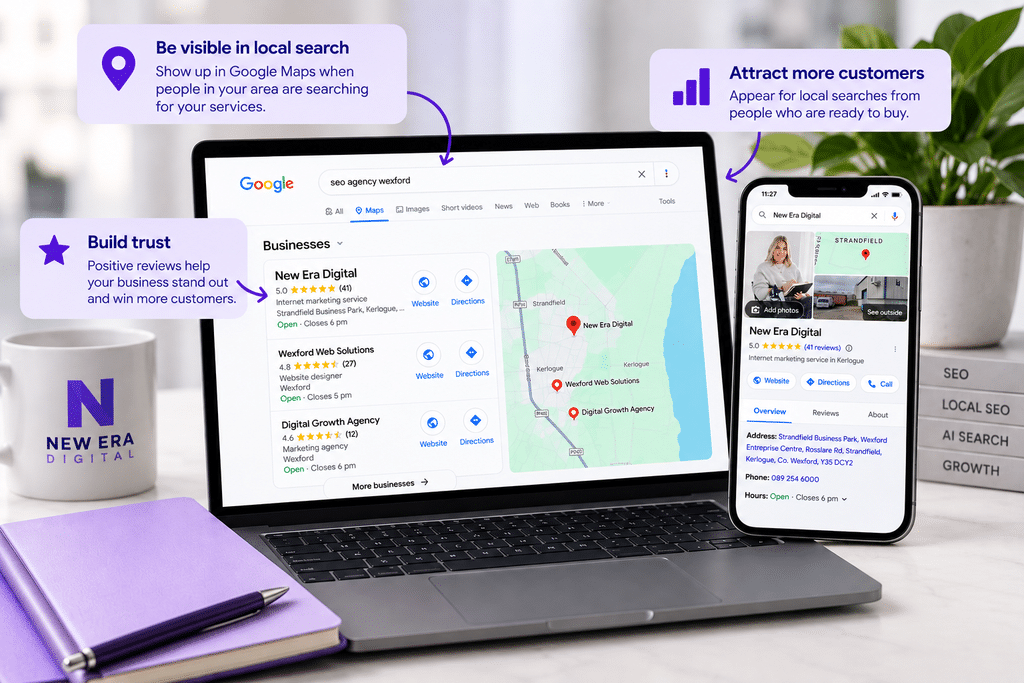
A local search can give your business visibility in several different places:
| Local search area | What appears | Why it matters |
|---|---|---|
| Google Maps | Businesses relevant to the search and location | Helps nearby customers discover your business, get directions or make contact |
| Local Pack | A prominent group of local businesses within Google Search | Can put your business in front of customers before the traditional organic results |
| Organic results | Website pages relevant to the service and location | Helps service, location and supporting pages attract local search traffic |
| AI-assisted search | Business information surfaced through AI-powered search experiences | Makes clear information about your services, locations, expertise and reputation increasingly important |
Your Google Business Profile can also allow someone to take action without visiting your website at all — such as calling you, getting directions or checking your opening hours.
That’s why I don’t treat your website and Google Business Profile as two completely separate jobs. They should support each other.
How does Google decide which local businesses to show?
Google says its local results are primarily based on three factors: relevance, distance and prominence.
| Local ranking factor | What it means | What you can influence |
|---|---|---|
| Relevance | How closely your business matches what someone is searching for | Services, website content, Business Profile categories and accurate business information |
| Distance | How close the business is to the searcher or the location used in their search | Limited — your genuine location and service area matter |
| Prominence | How established or well-known the business appears | Reviews, links, website authority and your wider online presence |
Google explains these factors in more detail in its guidance on how to improve your local ranking on Google.
One thing worth remembering is that you can’t optimise every factor.
If someone in Dublin searches for a local service and your business only operates in Wexford, adding the word “Dublin” to a page doesn’t suddenly make you the most relevant local business.
This is one of the reasons I focus on building visibility in the locations a business genuinely serves rather than creating dozens of pages for places it doesn’t.
Start with a five-minute local SEO check
Before changing anything, see what customers currently see.
1. Search your business name. Does the correct Google Business Profile appear? Are your contact details, opening hours, photos and reviews accurate?
2. Search your main service + location. For example, “accountant Wexford”. Does your business appear in Maps or the organic results?
3. Search another important service you offer. Does Google seem to understand that you provide it?
4. Look at the businesses appearing ahead of you. How complete are their profiles? What pages are ranking? What do their reviews and websites look like?
5. Visit your website on your phone. Can someone immediately understand what you do, where you operate and how to contact you?
Don’t panic if competitors are ahead of you.
The point of this exercise is to establish where the gaps actually are before you start trying to fix them.
1. Optimise your Google Business Profile
For most local SEO projects, your Google Business Profile is one of the first things I look at.
Your profile should accurately reflect your real business.
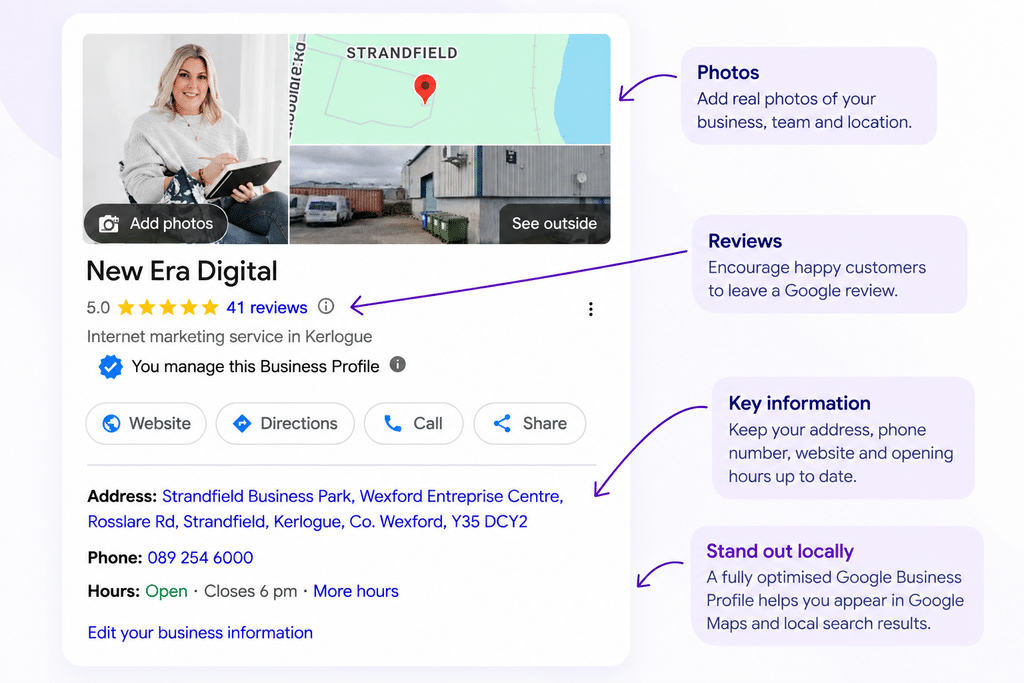
Check your:
- business name
- primary and secondary categories
- address or service area
- phone number
- website
- opening hours
- services
- business description
- photographs
- relevant business attributes
Your primary category is particularly important. Choose the category that most accurately represents your main business rather than the one you think sounds best for SEO.
Don’t add keywords to your business name unless they’re genuinely part of your real-world business name.
Keep the profile current too. If your opening hours, services or other important information change, update them. Google’s Business Profile help resources are useful if you’re unsure how a particular feature works.
And use genuine photographs of your business, team, work or premises where appropriate.
Your Google Business Profile is only one part of the strategy. Our Local SEO services look at the wider picture, including your website, local search visibility, reviews and authority.
2. Find the local searches your customers actually use
Don’t guess your keywords.
One of the first things I do when working on an SEO campaign is look at how people actually search for the client’s services.
There can be a surprisingly big difference between the terminology a business uses internally and what its customers type into Google.
For example:
Service + location
- psychologist Wexford
- accountant Dublin
- personal trainer Gorey
Local-intent searches
- plumber near me
- dentist near me
- coffee shop nearby
You can then map relevant searches to appropriate pages on your website.
That doesn’t mean putting every keyword and town name you find onto one page.
It means understanding what the person is actually looking for and creating a sensible website structure around those searches.
This is something I cover more broadly in our guide to SEO for small businesses.
3. Make your website locally relevant
Your Google Business Profile is important, but your website gives Google much more context about your business.
Your important pages should make it easy to understand three things:
What do you do?
Who do you help?
Where do you provide the service?
That information can appear naturally throughout your service pages, About page, contact information, case studies and supporting content.
For example, if you’re based in Wexford and work with customers throughout the county, it’s perfectly natural to talk about Wexford. Our own SEO Wexford page is designed specifically around businesses looking for SEO services in that market.
What I wouldn’t recommend is repeating “Wexford” every second sentence because someone told you that’s how local SEO works.
Write for the customer first.
4. Create useful location pages
Location pages can be extremely useful if you genuinely serve several different areas.
For example, a business operating across Wexford, Dublin and Kildare may have a genuine reason to create dedicated pages for those markets.
But there’s a big difference between a useful location page and creating 30 copies of the same page with the town name changed.
A good location page might contain:
- services available in that area
- genuinely useful local information
- relevant projects or case studies
- customer testimonials
- location-specific FAQs
- information about how you serve customers there
If the only unique word on your Dublin page is “Dublin”, you’ve probably got a problem.
This is also why I don’t automatically recommend creating a page for every town in a county.
Every location page should have a genuine purpose.
5. Build genuine Google reviews
Reviews can influence both visibility and whether someone chooses to contact you.
Even if two businesses appear next to one another in Google Maps, potential customers are likely to look at their ratings, number of reviews, how recent those reviews are and what customers actually say.
Make asking for reviews part of your normal customer process.
Google allows businesses to create a direct review link or QR code, making it much easier to send customers to the right place. You can follow Google’s instructions for creating a review link or QR code.
Don’t buy reviews or offer customers discounts, gifts or other incentives in exchange for them.
And don’t forget to respond to reviews.
At New Era Digital, we’ve built up 40+ Google reviews. They’re valuable for search visibility, but there’s another reason I care about them: prospective clients actually read them.
Reviews aren’t simply an SEO tactic.
They’re evidence from real customers that helps someone decide whether they trust your business.
6. Keep your business information accurate
You’ll often see SEOs talking about NAP, which simply means:
Name
Address
Phone number
You want important sources around the web to contain accurate information about your business.
This becomes particularly important if you’ve changed premises, telephone numbers or your business name. Old information can remain online long after you’ve forgotten about it.
I wouldn’t spend your week submitting your business to hundreds of random directories.
Focus on reputable platforms and directories that genuinely make sense for your location or industry, and make sure your important business information is accurate.
7. Build local authority
Local link building doesn’t have to mean buying backlinks.
Some of the best opportunities can come from what a business is already doing.
Think about:
- local organisations
- professional associations
- suppliers
- partnerships
- sponsorships
- events
- charities
- local media
- industry publications
One question I often use is:
Where would I reasonably expect an established business like this to be mentioned online?
Those can be much more valuable opportunities than chasing hundreds of low-quality directory links.
8. Don’t forget normal SEO
There’s sometimes a tendency to treat local SEO as though it exists separately from SEO.
It doesn’t.
Your website still needs strong foundations.
That includes:
- useful page titles and headings
- helpful content
- sensible website structure
- internal linking
- crawlability and indexation
- mobile usability
- site performance
- properly configured analytics
If Google struggles to understand or crawl your website, creating a perfectly optimised Google Business Profile won’t magically fix everything.
If you don’t know what’s holding your website back, a proper SEO audit can help uncover technical, content and on-page issues that may be limiting your visibility.
9. Use LocalBusiness structured data where appropriate
Structured data provides search engines with additional machine-readable information about a page and the entities represented on it.
For eligible businesses, LocalBusiness structured data can help Google understand information such as your business details, opening hours and location.
Google provides technical guidance on implementing LocalBusiness structured data.
I wouldn’t think of schema as a secret Local SEO ranking trick.
I see it as another way of making important information about the business clearer to search engines.
10. Avoid these common local SEO mistakes
After working on local SEO campaigns over the years, there are a few problems I see repeatedly.
Trying to rank nationally when the real opportunity is local
A small service business can sometimes get far more value from highly relevant searches in its actual service area than chasing a huge national keyword.
Creating thin location pages
Changing the town name on otherwise identical pages isn’t a location strategy.
Ignoring the website because you have a Google Business Profile
Your website and Business Profile should work together.
Setting up a Business Profile and forgetting about it
Business information changes. Opening hours change. Services change. Your profile should reflect the business as it exists today.
Not asking customers for reviews
Great businesses can end up looking less established online simply because nobody ever asks happy customers to leave feedback.
Focusing entirely on rankings
A number-one ranking that generates no enquiries isn’t necessarily more valuable than a lower-volume search that consistently brings in good customers.
Building poor-quality links purely for SEO
I’d rather see a business earn fewer genuinely relevant mentions than build hundreds of links from websites nobody has ever heard of.
11. Local SEO now goes beyond traditional Google results
The way people find businesses is changing.
A potential customer might use Google Search, Google Maps, Google’s AI-powered search experiences, ChatGPT, Gemini or another AI assistant while researching a service or deciding which businesses to consider.
That doesn’t mean you need to throw out everything you know about local SEO.
In many ways, the fundamentals become even more important.
Your business needs clear information about:
- who you are
- what you do
- where you operate
- your experience
- your reputation
- why someone should trust you
You also want consistency between what you say about your business and what credible third-party sources say about you.
I wouldn’t create an entirely separate “AI Local SEO” strategy.
I’d focus on making the business easy for search engines, AI systems and — most importantly — potential customers to understand and trust.
If you want to understand this side of search in more detail, our AI SEO & GEO services explain how we’re approaching visibility across traditional and AI-powered search.
12. Measure what actually matters
Don’t measure local SEO purely by checking where one keyword ranks.
I normally want to see a much broader picture.
Google Search Console
Look at the queries generating impressions and clicks.
Are more relevant local searches beginning to find you?
Are important service and location pages gaining visibility?
Google Analytics 4
What happens once someone reaches your website?
Are visitors submitting forms, making enquiries, booking appointments or reaching other important conversion points?
Google Business Profile
Review how people are finding and interacting with your Business Profile.
Leads and sales
Ultimately, this is the bit that matters.
A ranking improvement is nice.
More of the right enquiries, bookings and customers is better.
What should you prioritise?
If all of this feels like a lot, don’t try to do everything at once.
Start with the biggest gaps.
| Area | What to check | Priority |
|---|---|---|
| Google Business Profile | Categories, services, contact details, hours and photos | High |
| Reviews | Quality, recency, responses and your review process | High |
| Service pages | Useful pages for services customers actually search for | High |
| Location relevance | Areas served are clearly and naturally explained | High |
| Technical SEO | Mobile usability, crawling, indexing and performance | High |
| Location pages | Useful, unique pages for genuinely important locations | Medium |
| Citations | Accurate business details on relevant platforms | Medium |
| Local authority | Relevant links, mentions, partnerships and PR | Medium |
| Structured data | Appropriate LocalBusiness schema | Medium |
| AI visibility | Clear business, location, expertise and authority signals | Growing |
Free Local SEO Checklist
Want to check how your own local SEO is looking?
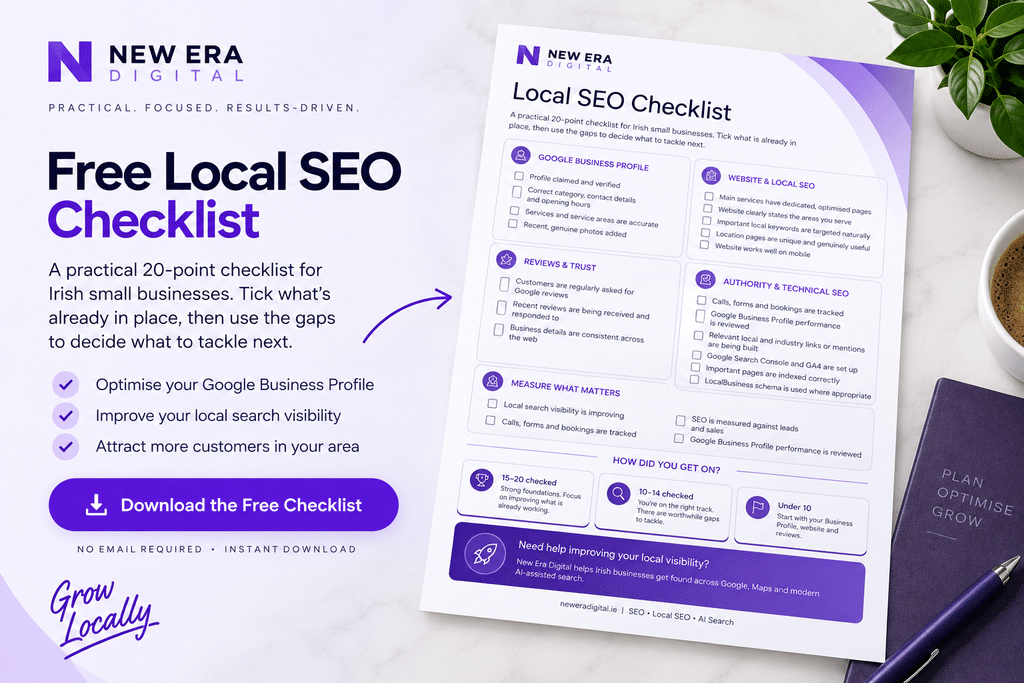
I’ve put together a simple 20-point Local SEO Checklist for Irish Small Businesses that you can download and work through at your own pace.
It covers your Google Business Profile, website, local relevance, reviews, technical SEO, tracking and modern search visibility.
Local SEO FAQs
Can I do local SEO myself?
Yes. There’s plenty a small business owner can do themselves.
You can maintain your Google Business Profile, keep your information accurate, ask customers for genuine reviews and make sure your website clearly explains what you do and where you operate.
Professional help tends to become more useful when you’re dealing with stronger competition, technical issues, multiple locations, keyword strategy, content, link building or simply don’t have time to manage it consistently.
What’s the difference between SEO and local SEO?
SEO is the broader process of improving a website’s visibility in organic search.
Local SEO places additional emphasis on searches with geographic intent and visibility within Google Maps, the Local Pack and locally relevant organic search results.
There’s considerable overlap between the two.
A strong website can support your local visibility, while local signals help search engines understand your relevance to customers in a particular area.
How do I do local SEO as a beginner?
Start with the basics.
Make sure your Google Business Profile is accurate and complete, identify the services and locations customers actually search for, optimise the relevant pages of your website, ask genuine customers for reviews and make sure your business information is consistent online.
Once those foundations are in place, you can work on content, location pages, authority and more advanced technical improvements.
How long does local SEO take?
There isn’t a universal timeframe.
It depends on where you’re starting, how competitive your market is, your location, your website, existing authority and what actually needs to be fixed.
An incomplete Google Business Profile may present relatively straightforward opportunities. Overtaking established competitors in a competitive location can require considerably more work.
I’d be wary of anyone guaranteeing a particular ranking within a particular number of weeks.
What are the most important local SEO ranking factors?
Google describes relevance, distance and prominence as the main factors behind its local results.
You can’t optimise away physical distance, but you can improve the signals that help Google understand your relevance and prominence through your Business Profile, website, reviews, authority and wider online presence.
Do I need a Google Business Profile for local SEO?
For businesses eligible for a Google Business Profile, it can be an extremely important part of local SEO because it enables visibility across Google Maps and other local search experiences.
But it isn’t the whole strategy.
Your website, reviews, links, business information and overall authority matter too.
Do I need a page for every location I serve?
No.
Create location pages when there is a genuine search opportunity, the location is relevant to your business and you can make the page useful to someone in that area.
I’d rather see five strong location pages than 50 virtually identical ones.
Want to improve your local visibility?
If you’re not sure why competitors are appearing ahead of you — or you simply don’t have time to manage all of this yourself — take a look at our Local SEO services.
We’ll look at the bigger picture: your website, Google Business Profile, local search visibility, competitors, reviews and authority, and identify where the strongest opportunities are.
Or, if you’d prefer to talk it through first, you can book a free 15-minute consultation with me.