Search is changing.
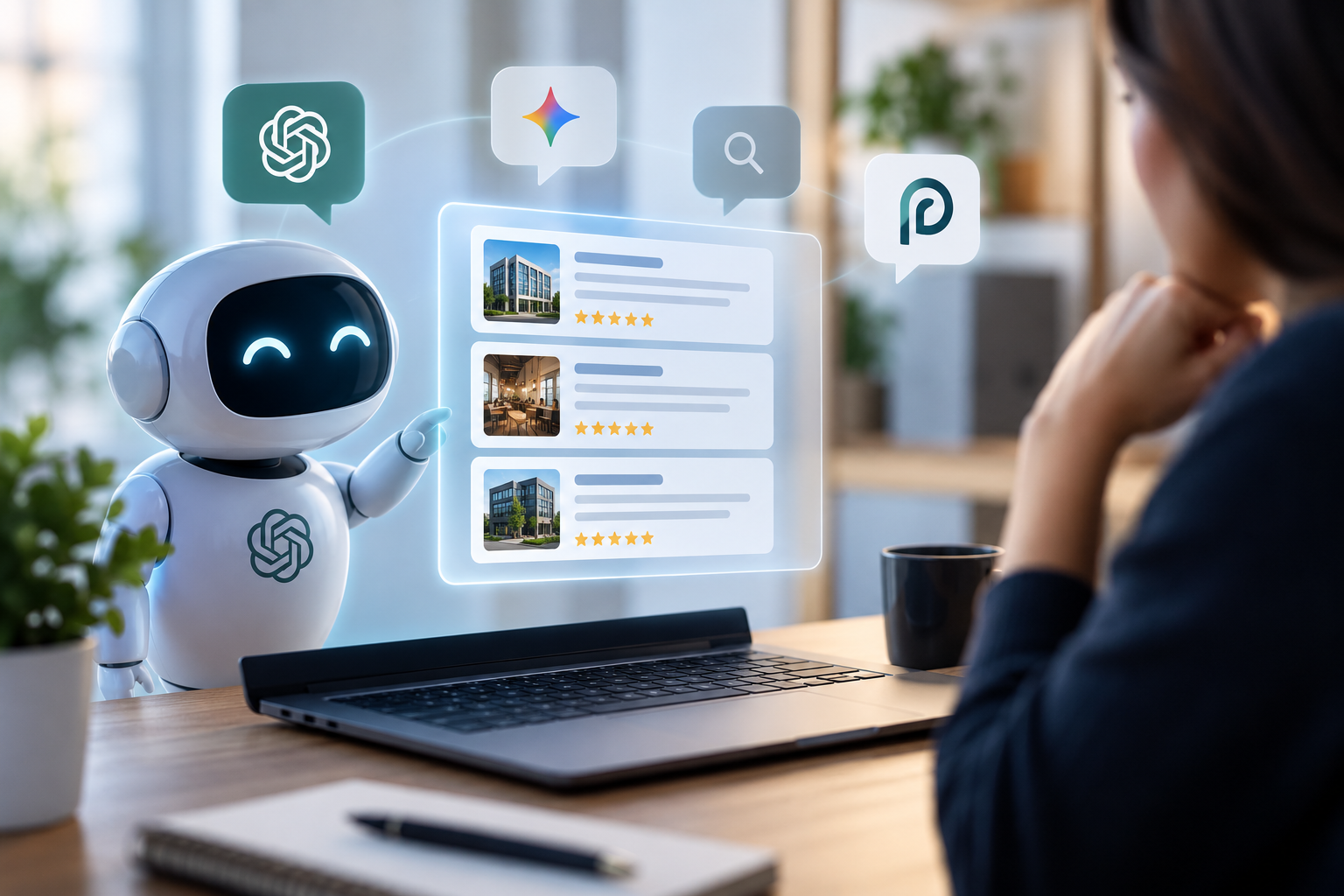
Your potential customers aren’t only typing queries into Google anymore. They’re asking ChatGPT, Google AI, Gemini, Perplexity and other AI-powered search tools questions such as:
“What’s the best SEO company for a small business in Ireland?”
“Recommend an accountant for a small business.”
“What’s the best product for this problem?”
“Which company would you recommend for this service?”
Instead of working through a list of search results themselves, they may receive a direct AI-generated answer containing a small number of businesses, products, brands or sources.
Naturally, this has created a new question for businesses:
How do I get AI to recommend my business?
There’s no switch you can flick, piece of schema you can install or prompt you can write that guarantees ChatGPT or another AI platform will recommend your business.
But there are things you can do to increase your visibility and make your business easier for AI systems to find, understand and verify.
That’s where Answer Engine Optimisation (AEO), Generative Engine Optimisation (GEO) and AI SEO come in.
And despite all the new terminology, much of the work starts with something we’ve been doing for years:
Good SEO.
What Is Answer Engine Optimisation (AEO)?
Answer Engine Optimisation (AEO) is the process of improving your content and online presence so that answer engines can understand and potentially use your information when responding directly to a user’s question.
Traditional SEO has largely focused on improving visibility within search results.
AEO focuses more heavily on becoming part of the answer itself.
That could mean your business or content being:
- cited as a source;
- mentioned within an answer;
- included in a recommendation;
- used to support an AI-generated response;
- surfaced for a relevant product or service.
You’ll also hear terms including AI SEO, AI search optimisation and GEO (Generative Engine Optimisation).
The terminology can get confusing very quickly.
For most businesses, the commercial objective is much simpler:
When somebody asks an AI platform about the products, services or expertise you provide, you want your business to have a chance of appearing in the answer.
AEO vs GEO vs SEO: What’s the Difference?
| Term | Main focus |
|---|---|
| SEO | Improving organic search visibility |
| AEO | Helping answer engines understand and use your information in direct answers |
| GEO | Improving visibility within generative AI responses |
| AI SEO | Broader optimisation across traditional and AI-powered search |
In practice, there’s considerable overlap.
Google’s own guidance now specifically addresses the terms AEO and GEO and says that, from Google’s perspective, optimising for generative AI search is still SEO. Its generative search experiences are rooted in Google’s existing Search ranking and quality systems.
So I wouldn’t abandon everything you know about SEO because somebody has invented another acronym.
AEO isn’t a replacement for SEO. It builds on it.
Can You Actually Get AI to Recommend Your Business?
You can improve the signals surrounding your business, but you cannot guarantee an AI recommendation.
I’d be wary of anybody promising otherwise.
Your goal isn’t to somehow tell ChatGPT:
“Recommend my company.”
It’s to build enough relevance, authority and clear information around your business that it becomes a credible candidate when somebody asks for what you provide.
I tend to think about four basic questions:
Does the AI understand who you are?
Does it understand what you’re known for?
Is there credible information supporting what you say about yourself?
Are you relevant to the particular question being asked?
That’s where AEO gets much more interesting than simply adding FAQs to your website.
Being Cited by AI vs Being Recommended by AI
There’s also an important distinction between being cited and being recommended.
An AI platform might cite one of your articles because it contains useful information without recommending your business as the company somebody should hire.
A recommendation is a more commercial outcome.
For example, there’s a difference between:
“According to New Era Digital, SEO costs in Ireland vary depending on scope…”
and:
“New Era Digital is one SEO company you could consider…”
Both provide AI visibility, but they serve different purposes.
That’s why I wouldn’t measure AEO purely by the number of citations your website receives.
For a business, the more interesting question is:
Are we appearing when potential customers ask AI tools to recommend companies, products or services like ours?
How to Get AI to Recommend Your Business
1. Start With Strong SEO Foundations
Before worrying about ChatGPT prompts or GEO tactics, make sure your fundamental SEO is in good shape.
That includes:
- crawlable and indexable pages;
- sensible website architecture;
- clear page titles and headings;
- useful service and product pages;
- strong internal linking;
- mobile usability;
- relevant content;
- clear business information;
- authority and relevant backlinks.
This isn’t old-fashioned thinking.
Google says its existing SEO best practices remain relevant for AI Overviews and AI Mode. Pages also need to be indexed and eligible for Google Search to appear as supporting links in these experiences.
At New Era Digital, this is why our AI SEO and GEO services build on traditional SEO rather than treating AI search as a completely separate channel.
2. Make It Clear What Your Business Is Known For
AI systems need to establish relationships between your:
business → people → services → products → expertise → industry → location
Your website should clearly explain:
- who you are;
- what you do;
- who you help;
- where you operate;
- the products or services you provide;
- what experience or expertise sits behind the business.
This sounds obvious, but many websites are full of clever marketing language without ever clearly explaining what the company actually does.
For my own business, for example, I want the relationship between Sarah Jane Vincent, New Era Digital, SEO, AI SEO, GEO, Google Ads and Ireland to be very clear.
And I don’t want that relationship to exist only on one page.
It should be reinforced naturally across the website and, ideally, elsewhere online.
3. Create Content Around Real Customer Questions
Think about what somebody asks before they choose a business like yours.
For my own potential clients, those questions might include:
How much does SEO cost in Ireland?
How do I choose the right SEO company?
How long does SEO take?
How do I measure SEO ROI?
How can I get my business recommended by AI?
These aren’t random blog ideas.
They’re questions people ask while researching a service and deciding what to do next.
Your content strategy should answer those questions properly.
That doesn’t mean adding dozens of FAQs to every page.
It means creating genuinely useful resources around the topics where your business has something worthwhile to contribute.
4. Give the Answer Clearly
If your heading asks:
Can I Guarantee My Business Will Appear in ChatGPT?
Don’t make the reader work through 600 words before you tell them.
No. You cannot guarantee that ChatGPT will recommend your business.
Then explain why and what they can do.
Clear content can use:
- descriptive headings;
- concise definitions;
- direct answers;
- useful lists;
- comparison tables;
- examples;
- supporting evidence;
- deeper explanation where it’s needed.
But don’t take this too far.
You don’t need to chop every article into tiny “AI-friendly chunks”. Google’s current guidance for generative AI search says there’s no need to rewrite content into short, fragmented sections simply for AI systems.
Write for people first. Make the information easy to understand second.
5. Add Something AI Can’t Easily Replicate: Your Experience
This is becoming increasingly important.
If your article says exactly the same thing as hundreds of other articles, why should it deserve attention?
Use:
- first-hand experience;
- client examples;
- original research;
- genuine opinions;
- case studies;
- observations from your work;
- original data where available;
- named experts.
I’ve worked in SEO and digital marketing for more than 15 years.
I’ve seen businesses at different stages, across different industries and with very different commercial objectives.
That gives me examples and opinions I can add to an article that don’t come from simply summarising the existing search results.
Your business has that knowledge too.
Use it.
Google’s guidance on optimising for generative AI recommends creating unique, non-commodity content and bringing first-hand experience and a distinctive point of view to it.
6. Remember That AI Recommendations Don’t Just Come From Your Website
This is one of the most important concepts to understand.
You can say you’re brilliant on your own website.
Of course you can. It’s your website.
But what does the rest of the web say about you?
Depending on the AI platform and query, information can be discovered from a much broader collection of sources.
Think about:
- relevant industry websites;
- reputable directories;
- professional associations;
- reviews;
- news and media;
- interviews;
- podcasts;
- expert contributions;
- professional profiles;
- awards;
- partnerships;
- genuine backlinks;
- independent brand mentions.
The aim isn’t to plaster your company name across hundreds of low-quality websites.
It’s to develop a credible digital footprint in the places where your business genuinely belongs.
Google’s generative AI search guidance also discusses how its systems may use information from sources such as blogs, forums and videos, while warning against trying to manufacture mentions purely to manipulate visibility.
7. Build Relevant Brand Mentions and Backlinks
Backlinks haven’t suddenly stopped mattering because AI arrived.
But I think we need to think about them more broadly.
A relevant third-party article mentioning your business can provide:
a link + a brand mention + context + independent corroboration.
Imagine a respected Irish business publication references me in an article about SEO investment and links to my guide on how much SEO costs in Ireland.
From a traditional SEO perspective, that’s a relevant backlink.
But it also creates another independent source connecting:
Sarah Jane Vincent → New Era Digital → SEO → Ireland → SEO pricing
That’s useful context around the brand.
This is why I’d focus on relevant, credible mentions and relationships, rather than chasing arbitrary link numbers.
8. Build Genuine Reviews and Reputation
If someone asks an AI platform for the best, recommended, trusted or top-rated business, reputation is clearly relevant to the question.
Build genuine customer reviews on platforms appropriate to your business.
For a local company, Google reviews may be particularly important.
For another business, there may be relevant industry-specific platforms.
And look beyond the number of reviews.
A customer explaining:
what they hired you for → what you did → what result they experienced
provides far richer information than:
“Great company. Five stars.”
Don’t manufacture reviews for AEO.
Build a business worth recommending and make it easy for real customers to describe their experience.
9. Keep Important Business Information Consistent
Don’t make search engines and AI systems play detective.
Keep important factual information accurate where appropriate, including:
- business name;
- website;
- location;
- contact information;
- services;
- key people;
- professional profiles;
- opening information.
This is especially important for businesses targeting local customers.
If old addresses, inconsistent company names or outdated service descriptions are scattered around the web, tidy them up.
For local businesses, your wider Local SEO strategy remains part of this work.
10. Use Structured Data — But Don’t Treat Schema as an AI Hack
Structured data can help search engines understand information and make pages eligible for certain search features.
Use appropriate schema where it genuinely describes the content on the page.
But don’t install a schema plugin and assume you’ve “done AEO”.
Google is very explicit about this: there is no special structured data required to appear in AI Overviews or AI Mode.
The same applies to some of the newer technical recommendations circulating around AI SEO.
For example, Google’s generative AI optimisation guidance says you don’t need to create special machine-readable files such as llms.txt to appear in Google Search, including its generative AI features.
Technical optimisation matters.
Magic AI files don’t replace authority, content and good SEO.
11. Make Sure AI Search Tools Can Access Your Content
If you want public website content to be discoverable in AI search, make sure you aren’t inadvertently blocking relevant crawlers.
For Google, normal Googlebot crawling and indexing requirements apply to its AI search features.
For ChatGPT search, OpenAI states that public websites can appear in ChatGPT search and recommends ensuring that OAI-SearchBot isn’t blocked if you want your content to be discovered, surfaced and cited.
This is one of the technical checks I’d include in an AI visibility audit.
Because before we get clever about AEO, we should establish:
Can the platform actually access what we want it to find?
12. Strengthen Your Local Presence for Local AI Recommendations
There’s an important difference between:
“What does a physiotherapist do?”
and:
“Recommend a physiotherapist near me.”
The second has clear local intent.
Your location, services, reputation, reviews and local relevance therefore matter.
Make sure your website clearly communicates:
where you operate + what you provide + who you serve.
Keep your Google Business Profile current and build genuine local authority.
Google specifically recommends keeping Business Profile information up to date as part of its guidance for visibility in AI search experiences.
13. Build Topical Authority, Not a Random Blog Factory
Publishing more content doesn’t automatically make you authoritative.
I’d rather see a smaller collection of genuinely useful resources around the subjects a business actually knows about.
For New Era Digital, for example:
SEO services → SEO pricing → choosing an SEO company → SEO ROI → Local SEO → AI SEO → AEO → GEO.
Those subjects reinforce one another.
They also reflect what we actually do.
Compare that with publishing hundreds of loosely related keywords simply because a keyword tool showed search volume.
Google’s generative AI search guidance warns against producing large numbers of pages for query variations simply to manipulate traditional or generative search results.
Build depth around what you’re genuinely an expert in.
14. Don’t Create Generic AI Content to Rank in AI
There’s a certain irony here.
AI can be incredibly useful for research, analysis, ideation and improving workflows.
But producing hundreds of generic AI-written articles isn’t an AEO strategy.
If your article contributes nothing that wasn’t already available online, there’s little reason for it to stand out.
Add:
experience.
examples.
data.
research.
opinions.
case studies.
expertise.
Google doesn’t prohibit content simply because AI helped create it. Its guidance on generative AI content focuses on quality and warns against generating large numbers of pages without adding value for users.
The problem isn’t AI-assisted content.
It’s content that adds nothing.
15. Measure Whether AI Is Actually Recommending Your Business
This part matters.
If you’re investing in AEO or GEO, you need a baseline.
Don’t simply ask ChatGPT:
“Who is New Era Digital?”
That’s branded visibility.
Test discovery prompts, such as:
“Recommend an SEO company in Ireland for a small business.”
“Which Irish SEO agencies specialise in AI search?”
“Who offers SEO consultancy in Ireland?”
Then monitor:
- whether your brand appears;
- how it’s described;
- which competitors appear;
- which sources are cited;
- which topics trigger your brand;
- where you’re cited but not recommended;
- where you’re recommended but competitors dominate;
- whether visibility changes over time.
Also look at AI referral traffic and conversions rather than treating a mention as the end goal.
OpenAI says ChatGPT automatically adds utm_source=chatgpt.com to referral URLs, which means traffic from ChatGPT search can be identified in analytics platforms. You can read more in OpenAI’s guidance for publishers.
Google has also introduced a dedicated Generative AI performance report in Search Console, providing visibility data for generative AI features including AI Overviews and AI Mode.
The reporting includes information such as impressions, pages, countries, devices and performance over time, and Google confirmed that it had rolled these insights out to websites worldwide by 31 August 2026.
That’s an important development because AI visibility is becoming increasingly measurable rather than purely anecdotal.
What I’m Seeing From AI Search in Practice
One of the biggest changes I’m seeing is that AI search forces us to think beyond individual keyword rankings.
Traditional SEO often asks:
Where do I rank for this keyword?
AI visibility introduces different questions:
Is my brand being mentioned?
For which topics?
In response to which questions?
Am I being cited or actually recommended?
Which competitors are appearing instead?
Which external sources appear alongside those recommendations?
That’s why I don’t see AI SEO as something completely separate from SEO.
Technical SEO, content, authority, links, reputation, entities and user experience still matter.
What’s changing is how and where that information can be surfaced.
The objective isn’t simply:
Rank on page one.
It’s increasingly:
Be visible wherever your potential customer is looking for an answer.
AEO Checklist: How to Improve Your AI Visibility
| Area | What to check |
|---|---|
| SEO foundations | Can search engines crawl, index and understand your website? |
| Brand clarity | Is it obvious who you are, what you do and where you operate? |
| Content | Are you answering genuine customer questions? |
| Experience | Does your content contain information only you could provide? |
| Authority | Are credible third parties mentioning or linking to you? |
| Reviews | Is there genuine evidence of customer experience? |
| Entity signals | Are your brand, people, services and locations clearly connected? |
| Consistency | Is important business information accurate across the web? |
| Technical SEO | Can Google and relevant AI search crawlers access your content? |
| Local visibility | Is your local presence and reputation clear? |
| Measurement | Are you monitoring mentions, recommendations, citations and competitors? |
Frequently Asked Questions About Getting Recommended by AI
How do you get your business to show up in AI results?
Start with strong SEO foundations and make it easy to understand exactly what your business does. Create useful content, establish your expertise, build genuine authority and reputation, and develop credible third-party mentions.
There is no single AEO technique that guarantees inclusion.
How do you get your business recognised by AI?
Build a clear and consistent digital footprint connecting your business with its services, expertise, people and location.
Your website matters, but independent sources such as industry websites, reviews, professional profiles and media coverage can also strengthen the wider picture of your business.
How do I get AI to suggest my business?
You cannot force an AI system to recommend your company.
Instead, concentrate on becoming a relevant, credible and well-supported answer when somebody asks about the services or products you provide.
How can my business be found on ChatGPT?
Make your public website technically accessible, create useful content around the subjects your business genuinely knows about and strengthen your wider brand authority.
OpenAI recommends allowing OAI-SearchBot if you want your content to be discovered, surfaced and cited in ChatGPT search.
How do I get ChatGPT to promote my business?
You can’t instruct ChatGPT to promote your business organically.
A better objective is to make your business relevant and credible enough that it has the potential to appear when somebody asks for companies, services or expertise like yours.
Can I guarantee my business will appear in AI answers?
No.
AEO, GEO and AI SEO can improve your visibility and the signals surrounding your business, but nobody can guarantee that an independent AI platform will cite or recommend a particular company.
How long does AEO take?
There isn’t a universal timeframe.
An established business with strong search visibility, content, links, reviews and authority starts from a very different position from a new company with virtually no digital footprint.
I’d establish current AI visibility first, identify the gaps and measure progress from there rather than promising an arbitrary timeframe.
AEO Isn’t About Gaming AI
AEO is sometimes presented as if we’ve discovered a completely new algorithm that businesses need to manipulate.
I don’t think that’s a particularly useful way to approach it.
If you want AI systems to recognise and potentially recommend your business, concentrate on becoming a credible answer in the first place.
Make your expertise obvious.
Publish genuinely useful information.
Build your reputation.
Earn relevant mentions.
Keep your business information clear.
Maintain strong SEO foundations.
And measure whether your visibility is actually improving.
The question shouldn’t really be:
“How do I trick AI into recommending my business?”
It should be:
“How do I make my business one of the most credible answers available when somebody asks for what we do?”
That’s the bigger opportunity.
At New Era Digital, our AI SEO and GEO services combine traditional SEO with AI search optimisation to help businesses strengthen their visibility across Google and emerging AI-powered search experiences.
If you’d like to understand where your business currently stands, book a free 15-minute consultation and we’ll start by looking at where you’re visible now and where the opportunities are.