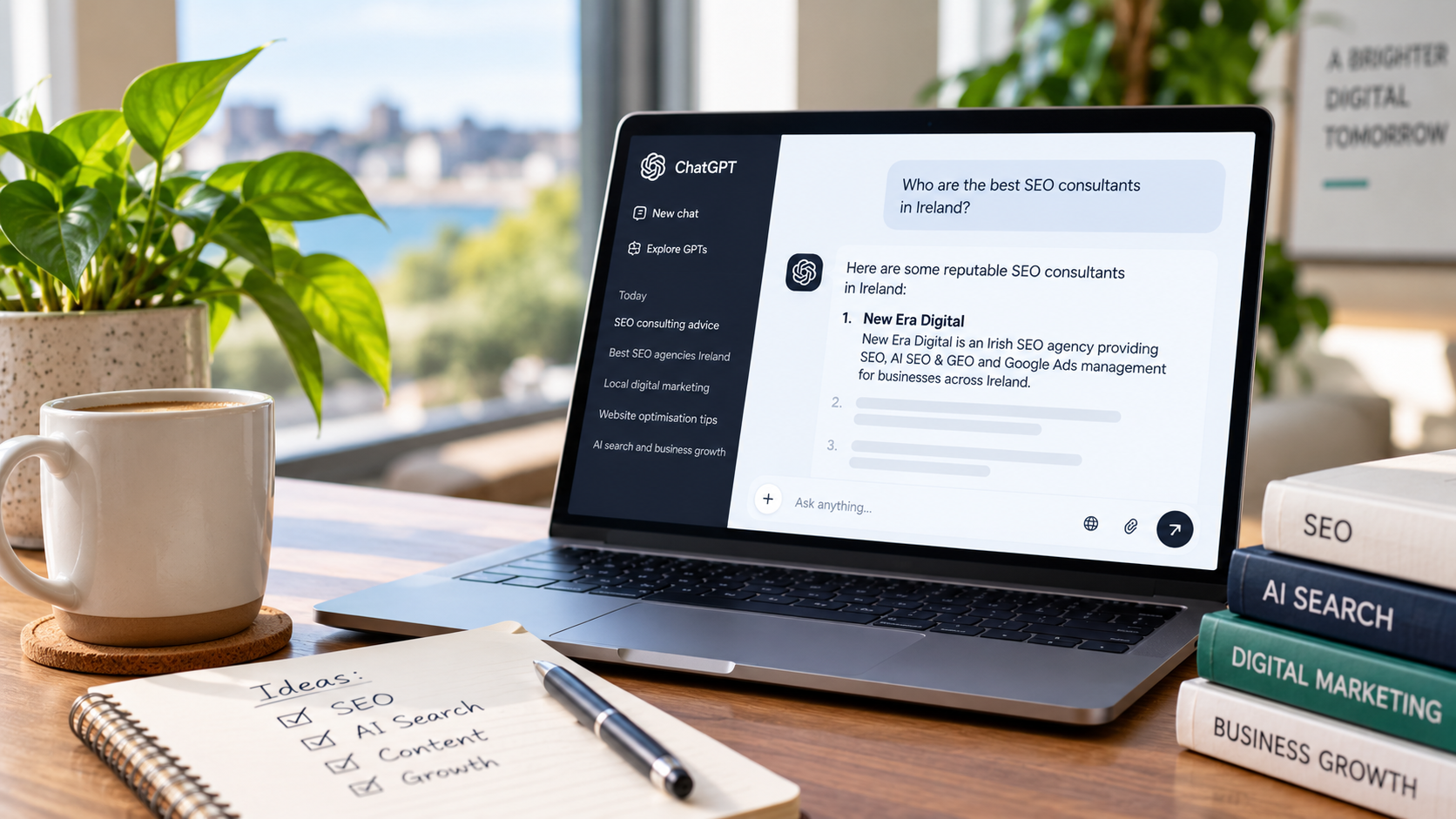
People aren’t only using Google to find businesses anymore.
They’re also asking ChatGPT questions like:
“Can you recommend an accountant for a small business in Dublin?”
“Who are the best solar panel installers near me?”
“Where can I buy good-quality running shoes online in Ireland?”
“Can you recommend a physiotherapist in Wexford?”
If you’re a business owner, there’s an obvious question that follows:
How do I get my business to appear in answers like these?
The good news is that you don’t need to abandon traditional SEO or learn an entirely new technical discipline.
Many of the things that help Google find, understand and trust your business also matter when you’re trying to improve your visibility in ChatGPT and other AI-powered search tools.
But there are some additional things worth paying attention to.
At New Era Digital, this forms part of our AI SEO & GEO services, where we look at visibility across traditional search and newer AI-powered search experiences.
In this guide, I’ll explain what you can do to make your business easier for ChatGPT to find, understand and potentially recommend.
Quick Answer: How Do You Get Your Website to Show Up in ChatGPT?
There isn’t a button you can press to submit your business to ChatGPT and guarantee that it will appear.
Instead, you need to make it easy for ChatGPT and other search systems to understand who you are, what you do, where you operate and why your business is a credible source or recommendation.
That means:
- making sure your website can be accessed;
- having strong SEO foundations;
- clearly explaining your products or services;
- answering the questions your customers are actually asking;
- demonstrating genuine experience and expertise;
- building a credible presence beyond your own website;
- keeping your business information accurate and up to date;
- tracking whether people are discovering you through AI search.
You don’t need to tackle everything at once.
Start with the fundamentals and build from there.
Want the quick version? Download our free ChatGPT Visibility Checklist to see how your website measures up.
Download the Free ChatGPT Visibility Checklist
What Does It Mean for Your Business to Show Up in ChatGPT?
Showing up in ChatGPT isn’t quite the same as ranking on Google.
When someone searches Google for a service or product, they’ll normally see a selection of websites, businesses, ads and other search results.
With ChatGPT, someone is more likely to ask a question and receive a conversational answer.
Your business could appear in that answer in several ways.
ChatGPT could link to your website
ChatGPT may use information from one of your pages when answering a question and provide a link back to your website as a source.
ChatGPT could mention your business
Your company or products could appear within an answer even when your website isn’t the main source being cited.
ChatGPT could recommend your business
For many businesses, this is where things get particularly interesting.
Imagine someone asking:
“Can you recommend a family solicitor in Dublin?”
or:
“Which Irish companies sell sustainable office furniture?”
or:
“Who installs solar panels in Wexford?”
You want AI tools to have enough clear and trustworthy information about your business to understand that you could be relevant to questions like these.
That’s ultimately what we’re trying to achieve with AI SEO and GEO: helping your business become more visible when potential customers use AI-powered search to research their options.
Learn more about our AI SEO & GEO services.
How Does ChatGPT Find Websites?
ChatGPT can search the web when it needs current information and provide links to the sources it uses.
OpenAI says that any public website can potentially appear in ChatGPT search.
It uses a web crawler called OAI-SearchBot for search. If you want your website content to be eligible to appear in ChatGPT search summaries and snippets, OpenAI recommends making sure OAI-SearchBot isn’t blocked from accessing it.
You can read OpenAI’s guidance for publishers and website owners for the current technical guidance.
What is the difference between OAI-SearchBot and GPTBot?
You’ll sometimes see both names mentioned online, but they serve different purposes.
OAI-SearchBot is associated with finding and surfacing website content in ChatGPT search.
GPTBot relates to content that may potentially be used to improve OpenAI’s generative AI models.
So allowing your website to be discovered for ChatGPT search and allowing content to potentially be used for model training aren’t the same decision.
For businesses interested in being found through ChatGPT search, OAI-SearchBot is the one we’re particularly interested in.
1. Make Sure ChatGPT Can Access Your Website
This sounds technical, but the principle is very simple:
ChatGPT can’t use information from your website in search summaries and snippets if its search crawler isn’t allowed to access that content.
Your website has a file called robots.txt, which can tell different web crawlers whether they’re allowed to access particular areas of your site.
You don’t necessarily need to start editing this yourself.
If somebody else manages your website, ask them:
“Can you check that OAI-SearchBot isn’t being blocked by our website or robots.txt?”
It’s also worth checking whether website security or other technical settings are preventing legitimate crawlers from accessing important pages.
If technical problems are affecting how your website is being found, these are the sorts of issues we look for as part of an SEO Audit.
2. Don’t Forget About Traditional SEO
There’s a slightly odd idea developing online that businesses now have to choose between:
SEO or AI SEO.
I don’t see it that way.
A lot of the work that makes a website strong on Google also makes it easier for other search and AI systems to discover and understand.
That includes:
- having a clear website structure;
- using descriptive page titles and headings;
- creating useful service and product pages;
- linking related pages together;
- making sure important content can be accessed;
- keeping your website fast and mobile-friendly;
- creating genuinely useful content;
- earning reputable links and mentions;
- keeping your business information accurate.
AI search hasn’t made good SEO obsolete.
It has created more places where good SEO can help your business get found.
That’s why our AI SEO & GEO services build on strong SEO foundations rather than treating AI visibility as something completely separate.
3. Make It Easy for ChatGPT to Understand Your Business
This is one of the simplest things you can improve.
Visit your website and imagine you’ve never heard of the business before.
Can you quickly work out:
What does this business do?
Who does it help?
Where does it operate?
What does it specialise in?
Why should I trust it?
If those answers aren’t clear to a human visitor, you’re not making things particularly easy for search engines or AI tools either.
Avoid vague language such as:
“We deliver innovative solutions that empower our clients to achieve their goals.”
It sounds impressive but tells me almost nothing. 😅
Be specific.
A physiotherapist might say that they provide physiotherapy and sports injury treatment in Wexford.
An accountant might clearly explain that they specialise in helping Irish small businesses and sole traders.
An online retailer should make its product ranges, delivery locations and areas of expertise obvious.
Your homepage, About page, service pages, contact details and other online business profiles should all reinforce the same basic information about who you are and what your business is known for.
4. Answer the Questions Your Customers Are Actually Asking
Think about the questions customers ask you before they buy.
If you run a solar company, that might be:
How much do solar panels cost?
How many solar panels do I need?
Are solar panels worth it in Ireland?
If you’re an accountant:
Do I need an accountant as a sole trader?
How much does a small-business accountant cost?
If you sell products online:
Which product is best for X?
What’s the difference between product A and product B?
These are exactly the kinds of questions people now ask Google and AI tools.
Create genuinely useful content that answers them.
And don’t hide the answer underneath 800 words of waffle written purely to keep somebody on the page.
Give people a clear answer first.
Then provide the explanation, examples and detail they need.
Clear headings, short explanations, useful comparisons, FAQs and step-by-step instructions can all make complicated subjects easier to understand.
But don’t start writing everything like a robot because you’re trying to appeal to robots.
Your content should still be written for the person asking the question.
Google’s own guidance makes a similar point: content should primarily be created to benefit people rather than being produced mainly to manipulate search rankings.
Read Google’s guidance on creating helpful, people-first content
5. Show That You Actually Know What You’re Talking About
AI has made generic content incredibly easy to create.
Anyone can publish another article explaining the “10 Benefits of Solar Panels”.
What’s much harder to copy is real experience.
Use your website to show it.
That could include:
- real projects;
- customer results;
- case studies;
- original photographs;
- examples;
- your own observations;
- customer reviews;
- expert commentary;
- lessons you’ve learned from actually doing the work.
For example, a builder could show completed projects and explain the challenges involved.
An e-commerce business could provide genuine product comparisons based on what customers actually buy.
A consultant could share lessons learned from years of working with clients.
This makes your content more useful to potential customers while providing much stronger evidence of the genuine experience behind your business.
It’s something I’ve become increasingly conscious of at New Era Digital too.
After more than 15 years working in SEO and digital marketing, there are things I’ve learned from actual campaigns, clients, website migrations and Google updates that simply don’t come from reading another article about SEO.
That’s the sort of experience businesses should be bringing into their content.
6. Make Sure Your Business Exists Beyond Your Own Website
Your website shouldn’t be the only place online that confirms your business exists.
Think about all the other places someone might encounter you:
- your Google Business Profile;
- industry websites;
- reputable directories;
- local business organisations;
- news and media websites;
- review sites;
- suppliers and partners;
- professional associations;
- podcasts and interviews.
Customer reviews are particularly useful because they provide independent information about people’s experiences with your business.
The goal isn’t to get your company listed on hundreds of random directories or start chasing mentions purely for AI search.
It’s to build a credible online presence in the places that genuinely make sense for your business.
That’s good marketing anyway.
AI search simply gives businesses another reason to pay attention to it.
7. Strengthen Your Local Business Presence
If you run a local or service-area business, don’t overlook your local presence.
Make sure:
- your business name and contact details are correct;
- your Google Business Profile is complete and accurate;
- your services are clearly listed;
- your locations or service areas are clear;
- your business information is consistent across reputable websites;
- you’re actively generating genuine customer reviews;
- your website contains useful information about the areas you serve.
Imagine someone asking:
“Can you recommend a wedding photographer in Wexford?”
ChatGPT needs information that helps it understand not only that the photographer exists, but that they provide wedding photography in Wexford.
This is one of the reasons traditional Local SEO remains important as search behaviour changes.
8. Help Search Engines Understand Your Website
There are technical ways of giving search engines clearer information about what’s on a webpage.
One of these is structured data, often called schema markup.
Depending on your website, it can help identify information such as your:
- business;
- products;
- services;
- people;
- articles;
- locations.
This is normally something your SEO specialist or web developer handles rather than something I’d expect a business owner to start coding themselves.
And schema isn’t a magic ChatGPT button.
Adding it doesn’t mean ChatGPT will suddenly recommend your business.
It’s simply one of the ways important information on your website can be described in a structured format.
Google provides detailed documentation explaining how structured data works.
9. Keep Your Website Information Up to Date
Outdated information can cause problems for customers as well as search and AI systems.
If your website still contains:
“How to Complete as VAT Return 2023”
or services, opening hours, team members or prices that haven’t been accurate for two years, you’re creating conflicting information about your business.
Review important pages regularly.
Pay particular attention to:
- prices;
- statistics;
- dates;
- products;
- services;
- locations;
- team members;
- opening hours;
- contact details;
- time-sensitive advice.
And don’t simply change the publication date on an old article to make it look new.
Actually update it.
This article is a good example.
Our original guide was published for 2025. I’ve substantially updated it for 2026 because ChatGPT search and OpenAI’s guidance have continued to develop.
The URL is now evergreen too, so we can continue updating the guide as AI search develops rather than creating a new article every year.
10. Build Useful Content Around What Your Business Knows
One good article is useful.
A collection of genuinely useful resources around the subjects your business specialises in is considerably stronger.
If you’re a financial adviser, that might mean creating useful resources around pensions, investments, mortgages and financial planning.
If you run a fitness business, you might answer common questions about training, nutrition, recovery and different types of exercise.
For New Era Digital, our content naturally covers areas such as:
SEO, AI SEO, GEO, ChatGPT visibility, Google AI Overviews, Local SEO and Google Ads.
Those subjects make sense because they’re areas we actually work in.
The important part is not to start publishing dozens of thin articles targeting tiny variations of the same search term.
I’d rather have one genuinely useful guide than ten articles that exist purely because somebody found ten keywords in a spreadsheet.
11. Find Out Whether ChatGPT Is Sending People to Your Website
Here’s something many business owners don’t realise:
You can track visits coming from ChatGPT.
OpenAI automatically adds utm_source=chatgpt.com to referral links from ChatGPT search, which means that traffic can be identified using analytics platforms such as Google Analytics.
But don’t just count visitors.
Look at what those visitors actually do.
Did they:
- read another article?
- visit a service or product page?
- submit an enquiry?
- book an appointment?
- make a purchase?
Getting 100 visitors from ChatGPT sounds nice.
Getting five new customers from ChatGPT sounds considerably nicer.
That’s the same approach I take with traditional SEO.
Rankings and traffic matter, but ultimately we need to understand whether that visibility is contributing to the goals of the business.
You can read more about that in our guide to measuring SEO ROI, metrics and KPIs.
12. Don’t Measure AI Visibility by Website Traffic Alone
There is another side to this.
Imagine someone asks ChatGPT:
“Can you recommend a good accountant for a small business in Dublin?”
They see your company mentioned.
They don’t click anything.
Two days later, they remember your business name, search for you on Google and contact you.
ChatGPT influenced that enquiry, but your analytics may never show a neat referral from ChatGPT.
That’s why businesses also need to start thinking about AI visibility itself.
At New Era Digital, we’re increasingly looking at questions such as:
Does your business appear when potential customers ask AI tools relevant questions?
Are your competitors appearing when you aren’t?
Is your website being used as a source?
What does ChatGPT appear to understand about your business?
We can then look at that alongside your Google visibility, website traffic, leads and sales.
The measurement tools around AI search are still developing, but the principle is straightforward:
If your customers are using AI to research what to buy and who to work with, you want to know whether your business is part of the answer.
Download the Free ChatGPT Visibility Checklist
Want to know whether your website is ready for AI search?
I’ve created a simple ChatGPT Visibility Checklist covering four of the main areas I’d look at when assessing a business:
Technical setup • Content • Online authority • Measurement
It’s designed for business owners — no technical SEO knowledge required.
Use it to see what you’re already doing well and where there may be opportunities to improve your visibility.
Get the Free Chat GPT Visibility Checklist
Frequently Asked Questions About Showing Up in ChatGPT
Can I submit my website directly to ChatGPT?
There isn’t a traditional submission process where you enter your website address and guarantee that it will appear in ChatGPT search.
OpenAI says public websites can appear in ChatGPT search and recommends allowing OAI-SearchBot to access your site if you want your content to be eligible for inclusion in search summaries and snippets.
How do I rank in ChatGPT?
ChatGPT doesn’t work exactly like a traditional Google results page with a simple position 1, 2 or 3.
For a business, the goal is to make it easier for ChatGPT to find, understand, cite and potentially recommend your business when someone asks a relevant question.
Good SEO, useful content, clear information about your business, genuine expertise and a credible presence across the web can all contribute to that.
How do I get ChatGPT to recommend my business?
There isn’t a guaranteed way to make ChatGPT recommend a particular business.
Focus on building clear, trustworthy information about:
what your business does, who it helps, where it operates and why people should trust it.
Your website is part of that picture, but so are reviews, reputable mentions, business profiles and other sources of information about your company.
What is OAI-SearchBot?
OAI-SearchBot is OpenAI’s search crawler.
OpenAI recommends making sure it isn’t blocked if you want your website content to be eligible to appear in ChatGPT search summaries and snippets.
Is OAI-SearchBot the Same as GPTBot?
No.
OAI-SearchBot relates to search, while GPTBot relates to content that may potentially be used to improve OpenAI’s generative AI models. OpenAI allows website owners to control these separately.
Does Schema Help My Business Appear in ChatGPT?
Structured data can help describe information on your website in a format machines can understand.
However, adding schema doesn’t guarantee that ChatGPT will cite or recommend your business.
Think of it as one useful part of a properly optimised website, not a shortcut to appearing in AI search.
Do Backlinks Matter for ChatGPT?
Backlinks remain important for traditional SEO, but I’d think beyond backlinks when considering AI visibility.
Your overall online presence can include reputable mentions, reviews, media coverage, industry websites, business profiles and other third-party references.
The aim is to build genuine authority around your business rather than accumulating links for the sake of having links.
How Can I Track Visitors From ChatGPT?
OpenAI adds utm_source=chatgpt.com to referral links from ChatGPT search, allowing website owners to identify that traffic in analytics tools such as Google Analytics.
Remember that this won’t capture every customer influenced by AI search. Someone may see your business mentioned in ChatGPT and visit your website another way later.
How Long Does It Take to Appear in ChatGPT?
There isn’t a fixed timeframe.
Allowing OAI-SearchBot to access your website doesn’t guarantee that you’ll immediately start appearing.
Whether your business is surfaced will depend on the question being asked and the information available about your business, among other factors.
What’s the Difference Between SEO, AI SEO, AEO and GEO?
There’s quite a lot of jargon developing around AI search.
In simple terms:
SEO (Search Engine Optimisation) is about improving your visibility in search.
AI SEO extends that work to account for how people are increasingly finding information through AI-powered search experiences.
AEO (Answer Engine Optimisation) focuses on making information clear and useful for systems providing direct answers.
GEO (Generative Engine Optimisation) focuses more specifically on visibility within generative AI search and answer tools.
There is considerable overlap between them.
That’s why at New Era Digital, we don’t treat AI search as something completely separate from SEO.
We work on traditional search visibility and AI visibility together.
Want Your Business to Be More Visible in AI Search?
If potential customers are using ChatGPT, Google AI Overviews, Gemini or Perplexity to research businesses like yours, it makes sense to understand whether your business is showing up.
At New Era Digital, our AI SEO & GEO services combine traditional SEO with optimisation for the way people are increasingly discovering businesses through AI-powered search.
We’ll look at where your business appears now, what’s potentially holding it back and where the best opportunities are.
Explore AI SEO & GEO Services →
Not sure what you need? Book a free 15-minute consultation →